I opened Chapter 2 with the claim that “#TheScience is not well.” I glossed over specifics in favor of getting into some more important foundational matters,1 but before we get too far removed from the assertion it’s probably a good time to provide some evidence in support of it, to put some meat on the bones of my assertion that hashtag-science, and most of what we think of as public science, is in very bad shape. To support my claim, I will not simply point out the trenchant aspects of the Covid-19 medical autocracy, or the “replication crisis,” or the Photoshopped doctoring of landmark studies in Alzheimer’s research, or the ongoing Climate Science fraud – although I will do that, too. I take the position that those alone would be sufficient to suggest that any culture’s science isn’t sciencing the way it should, but we’ll leave those arguments for now.2
I. Why Is It Like This?
Instead, I am going to focus more on the intellectual roots of this problem and show how those causes have impacted both Science and the Law. The specific instances with #science that I’ve listed above – and so many more – are mere symptoms of a much more insidious disease, a cancer that is destroying the Body Scientific from the inside. And the reason I choose this argument over other equally damning indictments is twofold: first, because our goal isn’t to destroy Science, but to show how it has been hijacked by a demonstrable wrong turn in the philosophy of science, and second, because there are infinite ways to be wrong and so we endeavor to do something more affirmative.3 This “debate” in science and philosophy of science might be better called a schism, reminiscent of the one in the Catholic church, but this one begins with David Hume’s inductive skepticism, owes some of its intellectual origins to European upper society’s fascination with “games of chance,” but it truly manifests in the American body scientific as a result of the work of two academics: Karl Popper and Ronald Fisher. (We’ll get to them in a little more detail in Part 2 of this science-philosophy history.)
Before we go down that hole with the white rabbit, however, I feel compelled to point out at this juncture that intellectual history as a serious endeavor – the study of the history of ideas and their consequences – is a subject that suffers from being simultaneously (1) critical for human advancement, and (2) more boring than a Catholic priest at CCD class explaining the concept of the Trinity to 2nd graders.4 I aspire to make this slightly more interesting, but also to convince you that the current state of science is not an accident – it is exactly what one should expect given the wrong turn that the academic philosophy of science and statistics departments took at universities at the beginning of the 20th century. I aim to show that this mess is the natural and foreseeable consequence of a cluster of ideas that come out of the psychological urge for certainty. Karl Popper in philosophy of science, and Ronald Fisher in statistics, won a war in the academe that had profound downstream consequences.5 The law eventually followed down that same wrong path when dealing with scientific evidence – and you wind up with one of the greatest miscarriages of justice ever, in my opinion: prosecuting an innocent mother, Sally Clark, on top of – and for – the deaths of her two young sons because of an innumerate society that produces innumerate judges and lawyers.6
II. Foundations: (Newton first, but then…) Laplace Explains How His Mind Works.
Before dealing with the origins of bad science, we have to begin with the good science – and perhaps the goodest of them all: Pierre Simon, marquis de LaPlace has a strong claim to being the greatest scientist ever. As good a claim as Aristotle, or Bacon, Newton, or Einstein, or Warburg, or Curie, or any other you could likely come up with. But there’s a more important reason for mentioning him here, and it is the same reason for which I elevate him above Isaac Newton in my personal pantheon: Laplace provided a unique insight – which few other “greats” ever have – as to how exactly his “genius” functioned. Newton believed that his insights came directly from God – and maybe in some sense that is an accurate way of conceiving of it – but Laplace explained his modes of thought and made them accessible to posterity by his explication of probability theory. His demonstrated use of it in solving problems made his “genius” intelligible and practical – accessible and usable – for those of us far below his understanding (or who don’t get a direct download on physics problems from the Almighty a là Newton).
Notwithstanding my elevation of LaPlace, we do begin this whirlwind tour of the intellectual history of the philosophy of science in the century following the publication of Newton’s Philosophae NaturalisPrincipia Mathematica, or “Mathematical Principles of Natural Philosophy”, in 1687. There are not always clear cut inflection points in the history of ideas, but the publication of Newton’s Principia is pretty hard to argue against in the context of our modern world. While it was not viewed with quite the same awe in its own day as it is now, it justifiably dominated Continental scientific inquiry, discussion, and the philosophy of science, for a century and beyond. Its greatness – the sheer power of the laws of motion – cannot be overstated, but no small part of that retrospective view of it stems from what Laplace and others did to confirm and expand upon Newton’s original work.7 In the decades following its publication, however, it was understood that the Principia had problems, and not exactly minor ones, even on its own terms.8
Newton postulated that there was an invisible force acting between a falling object and the Earth, and that this invisible force similarly acted between Earth and our Moon, and other celestial bodies, including the Sun and other planets. His equation explaining the relationship between the mass of the bodies and the square of the distance worked exceedingly well, but the Principia couldn’t and didn’t account for oddities in the observed orbits of Jupiter and Saturn, among some other problems. Additionally, in another part of the Principia, Newton’s formula for calculating the speed of sound was slow by roughly 20% when compared with well-established empirical measures for the speed of sound.9
It was Laplace’s obsession with – and understanding of – the error rates in Newton’s calculations – the difference between empirical observations and Newton’s predictions – that led to not just a better understanding of how the solar system formed, or a more accurate number for the transmission of sound through air, or of the eccentricity of the Earth its effect on ocean tides, or the mass of Saturn’s moon, etc. but more importantly for our purposes, Laplace’s explication of probability theory expressly laid out how anyone can use probability to advance their knowledge in the face of uncertainty. He summed this up in a later work.10
I present here without the aid of analysis the principles and general results of this theory, applying them to the most important questions of life, which are indeed for the most part only problems of probability. Strictly speaking it may even be said that nearly all our knowledge is problematical; and in the small number of things which we are able to know with certainty, even in the mathematical sciences themselves, the principal means for ascertaining truth, induction and analogy, are based on probabilities; so that the entire system of human knowledge is connected with the theory set forth in this essay. Doubtless it will be seen here with interest that in considering, even in the eternal principles of reason, justice, and humanity, only the favorable chances which are constantly attached to them, there is a great advantage in following these principles and serious inconvenience in departing from them…
Pierre Simon, marquis de laplace
II. … But also, there was Hume.
Into this explosion of scientific and philosophical inquiry, which I note were not viewed as distinct branches of inquiry at the time, David Hume (1711-1776) made his appearance and contributions. On a personal level, I have a certain fondness for the Scottish philosophe – right or wrong, he was one of the great curmudgeons of his day. Among the (many) ideas that he argued against, one was the “God as Watchmaker” thesis as proof of God’s existence.
The original analogy played a prominent role in natural theology and the “argument from design,” where it was used to support arguments for the existence of God of the universe, in both Christianity and Deism. Prior to Paley, however, Sir Isaac Newton, René Descartes, and others from the time of the Scientific Revolution had each believed “that the physical laws he [each] had uncovered revealed the mechanical perfection of the workings of the universe to be akin to a watch, wherein the watchmaker is God.”[2]
What he is most famous for, however, and more directly relevant to our topic of concern, are his arguments against induction, known broadly as his inductive skepticism.
David Hume first posed what is now commonly called “the problem of induction” (or simply “Hume’s problem”) in 1739 — in Book 1, Part iii, section 6 (“Of the inference from the impression to the idea”) of A Treatise of Human Nature. In 1748, he gave a pithier formulation of the argument in Section iv (“Skeptical doubts concerning the operations of the understanding”) of An Enquiry Concerning Human Understanding.
[…] According to the standard interpretation, Hume’s argument purports to show that our opinions regarding what we have not observed have no justification. The obstacle is irremediable; no matter how many further observations we might make, we would still not be entitled to any opinions regarding what we have not observed. Hume’s point is not the relatively tame conclusion that we are not warranted in making any predictions with total certainty. Hume’s conclusion is more radical: that we are not entitled to any degree of confidence whatever, no matter how slight, in any predictions regarding what we have not observed. We are not justified in having 90% confidence that the sun will rise tomorrow, or in having 70% confidence, or even in being more confident that it will rise than that it will not. There is no opinion (i.e., no degree of confidence) that we are entitled to have regarding a claim concerning what we have not observed. This conclusion “leaves not the lowest degree of evidence in any proposition” that goes beyond our present observations and memory (ToHN, p. 267). Our justified opinions must be “limited to the narrow sphere of our memory and senses” (EoHU, p. 36).11
*Trigger warning for Hume fans: now is the time when I (metaphorically) take the “great” philosopher David Hume out behind the woodshed.*
I do admire Hume’s claim for its audaciousness, the size and scope of its awesome contrariness: Hume is arguing that it’s impossible to learn anything at allfrom experience. Let’s just pause for a moment to consider our lives…You can draw NO INFERENCE AT ALL FROM FALLING out of a tree or off of a roof? Forget Newton’s law of universal gravitation for the moment – which had been published roughly 50 years before Hume’s “Treatise on Human Understanding” (1739) – people had been falling out of windows and off of roofs or having rocks crush them to death long before Newton described the forces with precision. Is Hume seriously suggesting that there’s a chance you could fall off of a ten-story building and somehow miss the ground? We can draw not even a mild inference at all (!!) from our experience as a child falling and smashing into the ground? Or from burning our hand by touching a hot metal teapot handle? Nothing – at all?!?
Not even the mentally ill believe this. Homeless people, the large majority of whom suffer from drug habits and mental illness, quickly ascertain which spots are better for panhandling (to get money for a fix or some food), or for sleeping (a warm subway exhaust grate), or are safer from the weather (under a bridge abutment). Their very survival – “the most important quiestions in [their] life” – depend upon inductive inferences and probabilistic determinations. i.e. Future events based upon past experience.
I will pose the question here and return to it in the next piece: could Hume have honestly believed such a thing? Could any sane human being?! Lest you think I’m making this up or exaggerating Hume’s position, please check any source that is thorough in recounting this issue, be it the Stanford Encyclopedia of Philosophy, or the Internet Encyclopedia of Philosophy, or Colin Howson’s “Hume’s Problem: Induction and the Justification of Belief.” Hume is saying that learning by induction is bullshit – that it can’t be done “rationally.”
Now some will say that I’m not doing justice to Hume’s argument, which is a more sophisticated logical argument that induction can only be justified by induction itself, which is what I’ve done above… and I would also bet a steak dinner that those defending Hume are academics. Notwithstanding, I promise to give this fuller treatment as we go along, to include pointing to the logical disproof of Hume on his supporters own terms – i.e. deductively or demonstratively.
For now, let’s step back for a moment to contrast LaPlace’s work and claims with Hume’s, and run it by what we’ve previously covered regarding the differences between demonstrative reasoning and plausible reasoning.
Laplace looked at Newton’s laws, saw where they diverged from empirical observation, and didn’t conclude that “God the Watchmaker” had to come by every so often to “wind up” his creation – and thereby correct its “errors” between human predictions (aka scientific models) and Reality. Laplace maybe God the benefit of the doubt, or more importantly, he didn’t engage in the Great Intellectual Sin: Reification, of confusing the map for the landscape.1212 Instead, Laplace refined Newton’s models by (for example) looking for where the additional 20% in the speed of sound might be found – it was in Newton’s wrongful assumption that the transmission of sound in air was isothermal, i.e. did not involve any temperature changes – Laplace initially had one of his students investigate what difference it would make if sound traveling in air was NOT isothermal (called adiabatic). Years before it could be confirmed experimentally, Laplace already knew that IF sound did involve temperature changes, the 20% difference could be accounted for. Laplace did this for the height of oceanic tides… and for the stability of the Universe… and for the orbits of Jupiter and Saturn… and for the weight of one of Saturn’s moons… and for the formation of the galaxy we live in.
Most of what Laplace did is still the “state-of-the-art” today, more than two-hundred years later. And here is a re-post of what I quoted Laplace saying about induction from above (with minor editing for clarity):
[T]he most important questions of life… are indeed for the most part only problems of probability. Strictly speaking it may even be said that nearly all our knowledge is problematical; and in the small number of things which we are able to know with certainty, even in the mathematical sciences themselves, the principal means for ascertaining truth, induction and analogy, are based on probabilities; so that the entire system of human knowledge is connected with the theory set forth in this essay.
As between Hume and Laplace, Hume (the academic and philosopher) is screaming that it’s impossible to advance human knowledge via inductive inference at the same time that Laplace (the scientist and philosopher) is out doing it in spades. I suggest that this comparison alone should be enough to relegate “Hume’s problem” to the dustbin of intellectual history, and that it does not is entirely because the problem exists in universities. It is “a problem” with academics in the ivory tower, but not for technologists like Elon Musk who is launching and catching rockets.
Philosophers are hardly ever cynical manipulators of their readers’ minds. They do not produce delusions in others, without first being subject to them themselves. —David Stove, “Idealism: a Victorian Horror-story (Part One)”
Pierre Simon Marquis de Laplace is engaged in parlance with the Universe; David Hume is screaming at the voices in his own head.
Hume’s problem has not gained its notoriety merely from Hume’s boldness in denying the epistemic credentials of all of the proudest products of science (and many of the humblest products of common-sense). It takes nothing for someone simply to declare himself unpersuaded by the evidence offered for some prediction. Hume’s problem derives its power from the strength of Hume’s argument that it is impossible to justify reposing even a modest degree of confidence in any of our predictions. Again, it would be relatively unimpressive to argue that since a variety of past attempts to justify inductive reasoning have failed, there is presumably no way to justify induction and hence, it seems, no warrant for the conclusions that we have called upon induction to support. But Hume’s argument is much more ambitious. Hume purports not merely to show that various, apparently promising routes to justifying induction all turn out to fail, but also to exclude every possible route to justifying induction.
“Handbook of the History of Logic. Volume 10: Inductive Logic,” Marc Lange
I offer this paragraph not to bolster Hume, but to point out that here is an academic speaking about Hume’s argument – that it’s impossible to learn from experience – and he speaks of it with awe and wonder, notwithstanding that he acknowledges in the first sentence that it runs counter to “the proudest products of science and many of the humblest products of common-sense.” He also points out that
It is a staple of introductory philosophy courses, annually persuading scores of students of either the enlightening or the corrosive effect of philosophical inquiry – since the argument appears to undermine the credentials of virtually everything that passes for knowledge in their other classes (mathematics notably excepted).
Id.
In other words, the delusion continues because academics can’t get over it and continue to perpetuate “Hume’s Problem” by brainwashing new students into its alleged profundity. “Inductive reasoning remains (in C.D. Broad’s famous apothegm) ‘the glory of Science’ and ‘the scandal of Philosophy’ [Broad, 1952, p. 143].” Lange, id. In reality, I believe this is nothing more than a literate version of your child asking, “but why?” “but why?” “but why?” until you eventually no longer have any answers and are forced to concede as much. Your child has not disproved that knowledge exists simply because you don’t have all of the answers to everything. I have labored over this perhaps too long, so I will conclude by introducing a minor character who certainly deserves more.
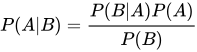
In the same rough timeframe that David Hume was rending his garments about induction (if you think I’m exaggerating, read his own comments), Thomas Bayes (1701-1761) was writing and publishing his only extant work in mathematics, Introduction to the Doctrine of Fluxions (1736), a work defending Isaac Newton against some critics. This is likely what got him admitted as a Fellow in the Royal Society in 1742. He is now far more famous than he ever was in life on the strength of an equation that wasn’t published until after his death. Bayes took ill in 1755 and died in 1761, his family passing along his manuscripts to Richard Price, who edited, wrote an introduction for, and then published Bayes’ work posthumously. Subsequently Price was admitted to the Royal Society for his work in defending and promulgating what we now know as Bayes’ theorem, found in “An Essay Towards Solving a Problem in the Doctrine of Chances” (1763). Bayes’ Theorem, as it has come to be known, is copied below, but it has to do with conditional probabilities.
It reads from left to right: “The probability of A given B is the probability of B given A multiplied by the probability of A all divided by the probability of B.” By the end of this course, you will be intimate with this and understand just how important and powerful it is – yes, even in the law. And how it relates to Sally Clark’s conviction in a British court.
In the same way I take the position that massive crop failures and famines resulting in starvation death by millions under Trosim Lysenko was sufficient to prove his country’s #science had some problems; ditto for Mao Zedong’s China. ↩︎
This is one way to conceive of the vast problems created by Karl Popper’s “definition” of science as being solely about falsification. We can spend eternity proving the various ways in which we are wrong without making any headway towards something approaching “right.” This is the essential difference between Laplace’s intellectual progeny and Hume’s – at least as explicated by Popper, et al. ↩︎
With apologies to the kind volunteer souls at Our Lady of Mercy in East Greenwich, RI cir. 1974-5. ↩︎
At the link, you will find a 2021 Op Ed by Richard Smith, former editor of the British Medical Journal, universally considered among the most prestigious journals in the world – it is entitled, “Time to assume that health research is fraudulent until proven otherwise?” It includes this quote: “We have now reached a point where those doing systematic reviews must start by assuming that a study is fraudulent until they can have some evidence to the contrary.” Yikes. ↩︎
This is a foot-stomp moment – it will be on the test. (There is no test). After we’ve gotten through the math-logic sections on conditional probability, sensitivity testing, and some of the fallacies around transposed conditionals, it will be worth revisiting the question of our claims about the misuse of frequentist statistics in light of Sally Clark’s case, and other “scientific evidence” presumptions in the law. ↩︎
It is worth observing that whether fortuitous birth circumstances or just the prevailing intellectual era, Newton (1643-1727) was followed by a succession of brilliant minds who all worked tirelessly to move the Principia forward in the next century: L. Euler (1707-1783), A. C. Clairaut (1713-1765), J. L. R. d’Alembert (1717-1783), J. L. Lagrange (1736-1813), and P. S. Laplace (1749-1827). ↩︎
Nothing I say anywhere should be taken in any as a denigration of Newton’s work. whatsoever. The accuracy of Newton with regard to universal gravitation was embedded into everything that followed it – and still is. ↩︎
See, e.g., “Laplace and the Speed of Sound,” Bernard S. Finn, ISIS: Journal of the History of Science, Univ. of Chicago Press, 1964; VOL. 55, No. 179. Newton’s tidal predictions were also updated and corrected by Laplace’s later work, which continues to be the standard understanding for how tides are measured. ↩︎
Because wordpress won’t let me footnote in pull quotes, the citation is “An Essay on Probabilities,” P. S. Laplace, trans. from the French Sixth Ed., Wiley and Sons, 1902, Introduction, p. 1. We will return to this quote later to fully investigate its meaning and application to the Law… after we’ve done the requisite math. ↩︎
“Handbook of the History of Logic. Volume 10: Inductive Logic,” Marc Lange (ed. by Dov Gabbay, Stephan Hartmann and John Woods). ↩︎
Comedian Stephen Wright had my favorite bit ever about reification in the mid-80s, it went something like this (in that wonderful deadpan monotone he made famous): “I have a map of the United States… it’s actual size. The scale says one mile equals one mile… last summer I folded it.” ↩︎
From ded thred. M60 with remote operation for gopher control is overkill. Plus goes *clunk* when you first engage*. CIWS is already set up for remote operation.
*9/10 ambushes
Spudalicious
on April 22, 2025 at 8:20 pm
Good stuff. I’m currently slogging through “The Fabric Of The Cosmos” by Brian Green. Fascinating, but it requires attention.
Yeah, this can get deep quick. OTOH, when you see how much of what passes for science is not reproducible or outright fraud, it’s probably time for a post mortem on what’s going on.
kinnath
on April 22, 2025 at 9:16 pm
I am enjoying the series.
I am just too brain dead tonight to engage.
Yusef drives a Kia
on April 22, 2025 at 9:55 pm
My thoughts exactly, what did they lie to me about as a kid? Why did I need to learn the truth on my own,
Spudalicious
on April 22, 2025 at 10:48 pm
That is what is really sad. “Settled science” has become a buzz phrase. Which only means that the science has been politicized.
slumbrew
on April 22, 2025 at 9:07 pm
I’m really enjoying this series, Ozzy.
…your child asking, “but why?” “but why?” “but why?” until you eventually no longer have any answers and are forced to concede as much. Your child has not disproved that knowledge exists simply because you don’t have all of the answers to everything.
A pithy summation.
slumbrew
on April 22, 2025 at 9:09 pm
I meant to add – philosophy has its place but at the end of the day we have bridges that need building.
I kinda laugh that if I want to tell certain congresspersons my thoughts on their actions I must live in the area to do so. Obviously, its not an official form so knowing a zip code within their district will allow it.
kinnath
on April 22, 2025 at 9:49 pm
I thought you sent messages to Congress with Molotov cocktails. All the cool kids do.
Congress critters that are performing constituent services for non residents of their district foreign nationals?
pistoffnick (370HSSV)
on April 22, 2025 at 9:52 pm
*looks at recent county tax assesment*
*looks at recent Minnesoda tax payment*
*looks at POS rusty truck/daily driver*
*looks at recent electricity bill*
*looks at recent mortgage bill*
HOW THE FUCK DO YOU PEOPLE DO IT?
I’m bled out after this Friday’s check.
WTF? I work hard. I put in extra hours.
HOW THE FUCK DO YOU PEOPLE DO IT?
WHAT AM I DOING WRONG?
Sean
on April 23, 2025 at 4:30 am
You need to set up a nonprofit. Duh.
rhywun
on April 23, 2025 at 6:31 am
Gummint job.
Fourscore
on April 23, 2025 at 6:28 am
Looking at the food costs, folks with kids must be having a tough time.
slumbrew
on April 22, 2025 at 9:54 pm
Feeling so dirty rooting for Marchand in Panthers sweater. But I love the guy.
It’s weird for me as a B’s fan to see him wearing a Panthers sweater.
Yusef drives a Kia
on April 22, 2025 at 9:58 pm
Im in Glendale Ca right now and all I can say is please get me back to San Diego.
I spent my life in the hell of LA, and its absolutely sucks
pistoffnick (370HSSV)
on April 22, 2025 at 10:04 pm
I’ll just say that you can get really good tacos for cheap just outside the docks of Long Island, CA. The tongue tacos. DO IT!
Yusef drives a Kia
on April 22, 2025 at 10:09 pm
Diego for good Mexi, no other answer
Rat on a train
on April 23, 2025 at 5:10 am
Santa Ana is the place for Mexican.
slumbrew
on April 22, 2025 at 10:05 pm
You can get some good Armenian food, I guess.
Yusef drives a Kia
on April 22, 2025 at 10:08 pm
I had some, great honky white folks food!
Yusef drives a Kia
on April 22, 2025 at 10:11 pm
I should say Armenian
slumbrew
on April 22, 2025 at 10:12 pm
Pot roast?
Yusef drives a Kia
on April 22, 2025 at 10:16 pm
I got some nice brews from the locals, and always great people.
Of all the bullshit dealing with ethnicities in me career the Anrmenians have always been straightforward and paid their bills,
American as it gets
ZWAK, doktor of BRAIN SCIENCE!
on April 22, 2025 at 10:46 pm
Very well, thanks! Finally got back to the rec center yesterday and did thirty minutes on the “recumbent cross trainer” (albeit set to much lower resistance than I usually use) without mishap. The weather looks as if it will be lovely today, and my boss is still gone to his convention!
Getting rid of my box of boxes really opened up the kitchen. (Recycling day was yesterday, so they took the cardboard away). It’s amazing how different something look when there isn’t a big brick of compacted carboard breaking up the line of sight.
Weather looks tolerable here too. Since the top of my head was neatened, I should probably trim my beard, the unbalanced effect looks awful.
I’m trying to annoy TedS by hiding my kvetching. He’ll probably pretend it doesn’t work.
Gender Traitor
on April 23, 2025 at 6:19 am
Getting rid of my box of boxes really opened up the kitchen.
*groan*
Shit like that is why I think democracy is overrated.
WTF
on April 23, 2025 at 7:04 am
Yup, I’m sure her constituents will keeping on voting for that shit, because why wouldn’t they want to make $50/hour for flipping burgers?
Grumbletarian
on April 23, 2025 at 7:36 am
She starts off her response with “I was a small business owner”. I wonder how many of her small businesses could afford to pay every employee at least $50/hr?
Tres Cool
on April 23, 2025 at 5:02 am
suh’ fam
whats goody
Evan from Evansville
on April 23, 2025 at 5:54 am
Hey all! Gotta bounce for my conscious sedation procedure, and I’ve heard it’ll be fun.
Extra all lidocaine and hospital grade fentanyl to me, please. Should be a fascinating experience. I’m fairly good admt accumulating ’em.
Hope your days go as predictably as possible; living in Interesting Times isn’t always a blessing, but it’s far better than the tedium wrenching DC.
Gender Traitor
on April 23, 2025 at 5:58 am
Hope everything goes well, EfE!
Fourscore
on April 23, 2025 at 6:39 am
Morning to each and everyone of you (us). Sunshine today, another day in the fields.
Always more work to be done but that ain’t all bad.


too deep for me.
pie are square is a far as I got.
two pie are round
Pie are round, cornbread are square, even in south Minneapolis
Many people think pie are round. Pie are not round, pie are square.
Are vampires square or hip?
That will answer what Pie is.
Wasn’t it (hip)^(b^2)?
From ded thred. M60 with remote operation for gopher control is overkill. Plus goes *clunk* when you first engage*. CIWS is already set up for remote operation.
*9/10 ambushes
Good stuff. I’m currently slogging through “The Fabric Of The Cosmos” by Brian Green. Fascinating, but it requires attention.
Yeah, this can get deep quick. OTOH, when you see how much of what passes for science is not reproducible or outright fraud, it’s probably time for a post mortem on what’s going on.
I am enjoying the series.
I am just too brain dead tonight to engage.
My thoughts exactly, what did they lie to me about as a kid? Why did I need to learn the truth on my own,
That is what is really sad. “Settled science” has become a buzz phrase. Which only means that the science has been politicized.
I’m really enjoying this series, Ozzy.
A pithy summation.
I meant to add – philosophy has its place but at the end of the day we have bridges that need building.
“we”?
I thought this was a libertarian site!
I’m still an engineer at heart – even if I dropped it after 2 years.
I thought this was a libertarian site!
Oh, I’m sorry – I thought this was America!
The two really go hand in hand
I kinda laugh that if I want to tell certain congresspersons my thoughts on their actions I must live in the area to do so. Obviously, its not an official form so knowing a zip code within their district will allow it.
I thought you sent messages to Congress with Molotov cocktails. All the cool kids do.
Congress critters that are performing constituent services for non residents of their district foreign nationals?
*looks at recent county tax assesment*
*looks at recent Minnesoda tax payment*
*looks at POS rusty truck/daily driver*
*looks at recent electricity bill*
*looks at recent mortgage bill*
HOW THE FUCK DO YOU PEOPLE DO IT?
I’m bled out after this Friday’s check.
WTF? I work hard. I put in extra hours.
HOW THE FUCK DO YOU PEOPLE DO IT?
WHAT AM I DOING WRONG?
You need to set up a nonprofit. Duh.
Gummint job.
Looking at the food costs, folks with kids must be having a tough time.
Feeling so dirty rooting for Marchand in Panthers sweater. But I love the guy.
It’s weird for me as a B’s fan to see him wearing a Panthers sweater.
Im in Glendale Ca right now and all I can say is please get me back to San Diego.
I spent my life in the hell of LA, and its absolutely sucks
I’ll just say that you can get really good tacos for cheap just outside the docks of Long Island, CA. The tongue tacos. DO IT!
Diego for good Mexi, no other answer
Santa Ana is the place for Mexican.
You can get some good Armenian food, I guess.
I had some, great honky white folks food!
I should say Armenian
Pot roast?
I got some nice brews from the locals, and always great people.
Of all the bullshit dealing with ethnicities in me career the Anrmenians have always been straightforward and paid their bills,
American as it gets
If you want Armenian food, you go to Fresno.
That is where they all settled.
Glendale buddy, its Armenianville,
Nice town
The Mexican takeover of fast food continues. The one decent Popeyes in the state might as well be Popicitos now.
Good morning Glibertarians!
🫡🥓🍳☕️
https://www.youtube.com/watch?v=EDMDb8unsIA
🎶🎶
Morning Sean.
*waves*
Good morning, Sean, U, Ted’S., Stinky, and homey!
…and Roat!
Hey from the (419)
Back on the road again already?
Morning, How goes?
Very well, thanks! Finally got back to the rec center yesterday and did thirty minutes on the “recumbent cross trainer” (albeit set to much lower resistance than I usually use) without mishap. The weather looks as if it will be lovely today, and my boss is still gone to his convention!
How are you?
Getting rid of my box of boxes really opened up the kitchen. (Recycling day was yesterday, so they took the cardboard away). It’s amazing how different something look when there isn’t a big brick of compacted carboard breaking up the line of sight.
Weather looks tolerable here too. Since the top of my head was neatened, I should probably trim my beard, the unbalanced effect looks awful.
I’m trying to annoy TedS by hiding my kvetching. He’ll probably pretend it doesn’t work.
😃👍
Aw yeah 👍
Prolly my favorite tune of theirs.
My poor car is absolutely coated in pollen.
😫
Eww!
Clean up after that vegitative indecency/
Better your car than your cat.
Or your steaks.
https://twitchy.com/amy-curtis/2025/04/22/math-is-hard-and-probably-racist-oaklands-new-mayor-thinks-50-minimum-wage-will-solve-inflation-woes-n2411737
$50/hr
Sounds legit. Retards.
Why is a burger at McDonalds $100?
*groan*
Shit like that is why I think democracy is overrated.
Yup, I’m sure her constituents will keeping on voting for that shit, because why wouldn’t they want to make $50/hour for flipping burgers?
She starts off her response with “I was a small business owner”. I wonder how many of her small businesses could afford to pay every employee at least $50/hr?
suh’ fam
whats goody
Hey all! Gotta bounce for my conscious sedation procedure, and I’ve heard it’ll be fun.
Extra all lidocaine and hospital grade fentanyl to me, please. Should be a fascinating experience. I’m fairly good admt accumulating ’em.
Hope your days go as predictably as possible; living in Interesting Times isn’t always a blessing, but it’s far better than the tedium wrenching DC.
Hope everything goes well, EfE!
Morning to each and everyone of you (us). Sunshine today, another day in the fields.
Always more work to be done but that ain’t all bad.