
The “law” of averages and God playing dice

I. The Null Hypothesis Ritual.
The American Statistical Association (ASA) was founded on November 27, 1839; it is the second-oldest continuously operating professional society in the United States, behind only the Massachusetts Medical Society (founded in 1781). The ASA publishes a number of journals, on its own and in partnership with other organizations, including the Journal of the American Statistical Association (JASA) and The American Statistician (TAS). It is among the most important mathematical societies in the world on matters of statistics, including technique and interpretation.
By 2015, the problems (that I’ve been railing about) with p-values in scientific publishing had gotten so bad that the Board of the ASA decided to convene a 20-member panel to write an Editorial, later published in The American Statistician in March 2016.
Underpinning many published scientific conclusions is the concept of “statistical significance,” typically assessed with an index called the p-value. While the p-value can be a useful statistical measure, it is commonly misused and misinterpreted. This has led to some scientific journals discouraging the use of p-values, and some scientists and statisticians recommending their abandonment, with some arguments essentially unchanged since p-values were first introduced.
Most important for my purposes is that the editorial (finally) gets around to addressing the most common logical fallacy (-ies) around p-values, which is the notion that a p-value tells us anything at all about the strength of the hypothesis under consideration – it does not – despite frequentists’ most ardent secret desire, yet public denial of same.
P-values do not measure the probability that the studied hypothesis is true, or the probability that the data were produced by random chance alone.
Researchers often wish to turn a p-value into a statement about the truth of a null hypothesis, or about the probability that random chance produced the observed data. The p-value is neither. It is a statement about data in relation to a specified hypothetical explanation, and is not a statement about the explanation itself.
Wasserstein, R. L., & Lazar, N. A. (2016). “The ASA Statement on p-Values: Context, Process, and Purpose.” The American Statistician, 70(2), 129–133. https://doi.org/10.1080/00031305.2016.1154108
This March 2016 Editorial by Ronald Wasserstein, Executive Director of the ASA since 2007, and Nicole Lazar, Editor-in-Chief of the JASA and head of Penn State’s Statistics Department, and the rest of the Board of the ASA, changed exactly nothing at all about “research funding, journal practices, career advancement, scientific education, public policy, journalism,” or “law.” Having failed to do anything about the “reproducibility crisis,” three years later Wasserstein, Lazar, and Allen Schirm published another (even stronger) Editorial on the same subject, this time in their individual capacities:
The ASA Statement on P-Values and Statistical Significance stopped just short of recommending that declarations of “statistical significance” be abandoned. We take that step here. We conclude, based on our review of the articles in this special issue and the broader literature, that it is time to stop using the term “statistically significant” entirely. Nor should variants such as “significantly different,” “p < 0.05,” and “nonsignificant” survive, whether expressed in words, by asterisks in a table, or in some other way.
To move forward to a world beyond “p < 0.05,” we must recognize afresh that statistical inference is not—and never has been—equivalent to scientific inference (Hubbard, Haig, and Parsa 2019; Ziliak 2019).
The American Statistician, 2019, VOL. 73, NO. S1, 1–19: Editorial, https://doi.org/10.1080/00031305.2019.1583913
This second Editorial, it should be noted, had the same exact impact on the problems in “research funding, journal practices, career advancement,” et cet, as the previous one – which is to say, none whatsoever. If any of these apparently goode men and gentle lady had followed the career and writings of distinguished psychologist and professor Gerd Gigerenzer of the Max Planck Institute, they would have known that this outcome of their publication was well-nigh inevitable. The so-called scientific publishing industry should really be called the scientistic publishing: looks a lot like science, but really isn’t.
Professor Gigerenzer has for decades been standing like the mythical Colossus of Rhodes, holding his hand up against frequentist statistics/ significance testing in science, especially Null-Hypothesis Significance Testing (NHST), which is the statistical and philosophical infrastructure upon which virtually all “peer reviewed” journals are built. Professor Gigerenzer’s valiant attempt to explain just what the hell happened in science has gone completely unheeded, as far as I can determine, since at least 1987. Given his gentlemanly disposition he doesn’t say it that way, but he bears witness to – and documents – a stark change in his own field (psychology) during his professional career, coinciding directly with changes in statistical interpretation and experimentation. And as we shall see below, it didn’t stop in psychology.
II. The “Inference” Revolution
THE INFERENCE REVOLUTION
What happened between the time of Piaget, Kohler, Pavlov, Skinner, and Bartlett and the time I was trained? In Kendall’s (1942) words, statisticians “have already overrun every branch of science with a rapidity of conquest rivalled only by Attila, Mohammed, and the Colorado beetle” (p. 69).
What has been termed the probabilistic revolution in science (Gigerenzer et al., 1989; Krüger, Daston, & Heidelberger, 1987; Krüger, Gigerenzer, & Morgan, 1987) reveals how profoundly our understanding of nature changed when concepts such as chance and probability were introduced as fundamental theoretical concepts. The work of Mendel in genetics, that of Maxwell and Boltzmann on statistical mechanics, and the quantum mechanics of Schrödinger and Heisenberg that built indeterminism into its very model of nature are key examples of that revolution in thought.
…
But the real, enduring transformation came with statistical inference, which became institutionalized and used in a dogmatic and mechanized way. This use of statistical theory contrasts sharply with physics, where statistics and probability are indispensable in theories about nature, whereas mechanized statistical inference such as null hypothesis testing is almost unknown.
So what happened with psychology? David Murray and I described the striking change in research practice and named it the inference revolution in psychology (Gigerenzer & Murray, 1987). It happened between approximately 1940 and 1955 in the United States, and led to the institutionalization of one brand of inferential statistics as the method of scientific inference in university curricula, textbooks, and the editorials of major journals.
The figures are telling. Before 1940, null hypothesis testing using analysis of variance or 1test was practically nonexistent: Rucci and Tweney (1980) found only 17 articles in all from 1934 through 1940. By 1955, more than 80% of the empirical articles in four leading journals used null hypothesis testing (Sterling, 1959). Today, the figure is close to 100%. By the early 1950s, half of the psychology departments in leading U.S. universities had made inferential statistics a graduate program requirement (Rucci & Twency, 1980). Editors and experimenters began to measure the quality of research by the level of significance obtained.
Gigerenzer, G., “The SuperEgo, the Ego, and the Id in Statistical Reasoning” in A Handbook for Data Analysis in the Behavioral Sciences: Methodological Issues, ed. by Keren and Lewis (1993), pp. 311-339.
Prof. Gigerenzer’s publication list reads like a giant sign with “PLEASE! NO! STOP!” wherein he has been trying – unsuccessfully – to explain how and where things went wrong in statistical inference and to get people to stop using “the null ritual.”
See, e.g., Gigerenzer, G., & Edwards, A.G.K., “Simple tools for understanding risks: From innumeracy to insight,” British Medical Journal, 327, 741–744 (2003). See also Gigerenzer G., Krauss S., Vitouch O., “The null ritual: What you always wanted to know about null hypothesis testing but were afraid to ask,” in Kaplan D. (Ed.), SAGE Handbook on quantitative methods in the social sciences (pp. 391–408)(2004). Gigerenzer, G., “Statistical Rituals: The Replication Delusion and How We Got There,” Advances in Methods and Practices in Psychological Science, Volume 1, Issue 2, June 2018, pp. 198-218. https://journals.sagepub.com/doi/epub/10.1177/2515245918771329
Here’s a video of the good professor at the Broken Science Initiative – at a lecture of his I attended recently – along with a transcript of his talk, where he discusses some of this work, including the problems with the creation of, and obsession with, the null ritual.
So what do textbook writers do when there are two different ideas about statistical inference? One solution would have been, you present both. And maybe also Bayes or Tukey, and others, and teach researchers to use their judgment to develop a sense in what situation it’s not working and where it’s better to do this. No, that was not what textbook writers were going for. They created a hybrid theory of statistical inference that didn’t exist and doesn’t exist in statistics proper. Taking some parts from Fisher some parts from Neyman, and adding their own parts, mostly about the idea that scientific inference must be without any judgment.
That’s what I mean mindless… automatic.
And the essence of this hybrid theory is the null ritual.
Let me say this again for emphasis: the null-hypothesis significance testing (NHST) is a complete fiction. Gigerenzer has been (repeatedly) lecturing the scientific community about its origins – also to zero effect. The NHST is the bastard creation of textbook publishers. It is not a course in any mathematics curriculum. And just so people know what I’m talking about, here is how the null ritual is done (with my italicized comments):
- Assume that the “null hypothesis” is true – pause. What the hell is a “null hypothesis?” I am told that this is “assuming no effect” from the tested intervention. But why should we assume this “anti-hypothesis” at all? What does it have to do with science?
- Setting aside those problems for the moment, the next step is to set the significance interval at p = 0.05. “WTF- Why!? Why .05, as opposed to .0025, or .00125, or etc…? Who decided that number magically creates “significance” in the data.1
- If the data from our experiment is less than p = 0.05, then voila! “Significance.” What does this tell us about our hypothesis? NOTHING at all. And yet… the world over – in scientistic publishing – authors, publishers, reporters, and lay people on the ‘Net all assert confidently – and the lower the p-value, the more confidently – that this data constitutes “proof” that the hypothesis is most decidedly NOT the byproduct of this force they call “random chance.”2
- Profit!3
How accurately does our hypothesis or experimental setup describe reality? “Doesn’t matter! Just complete null ritual, Citizen. Significance follows.”
III. Does God Play Dice?
In physics, just like on the internet, we learn that “correlation does NOT equal causation…”
Well, yes, except that sometimes it does – in point of fact, a lot of times it does. Screaming “correlation does NOT equal causation” as a way of appearing internet smaaht is actually stating an exception the general rule, because in the physical world correlation quite often is causation.
Did you see that lightning flash right before you heard that sizzle-crack, followed by that big boom overhead? Are you telling me those highly-correlated events aren’t ACK-CHOO-ULL-LEE (also) causally related? Has the cat got your “correlation-does-not-equal-causation” tongue when you see a tornado spiral out of a giant midwest thunderstorm?
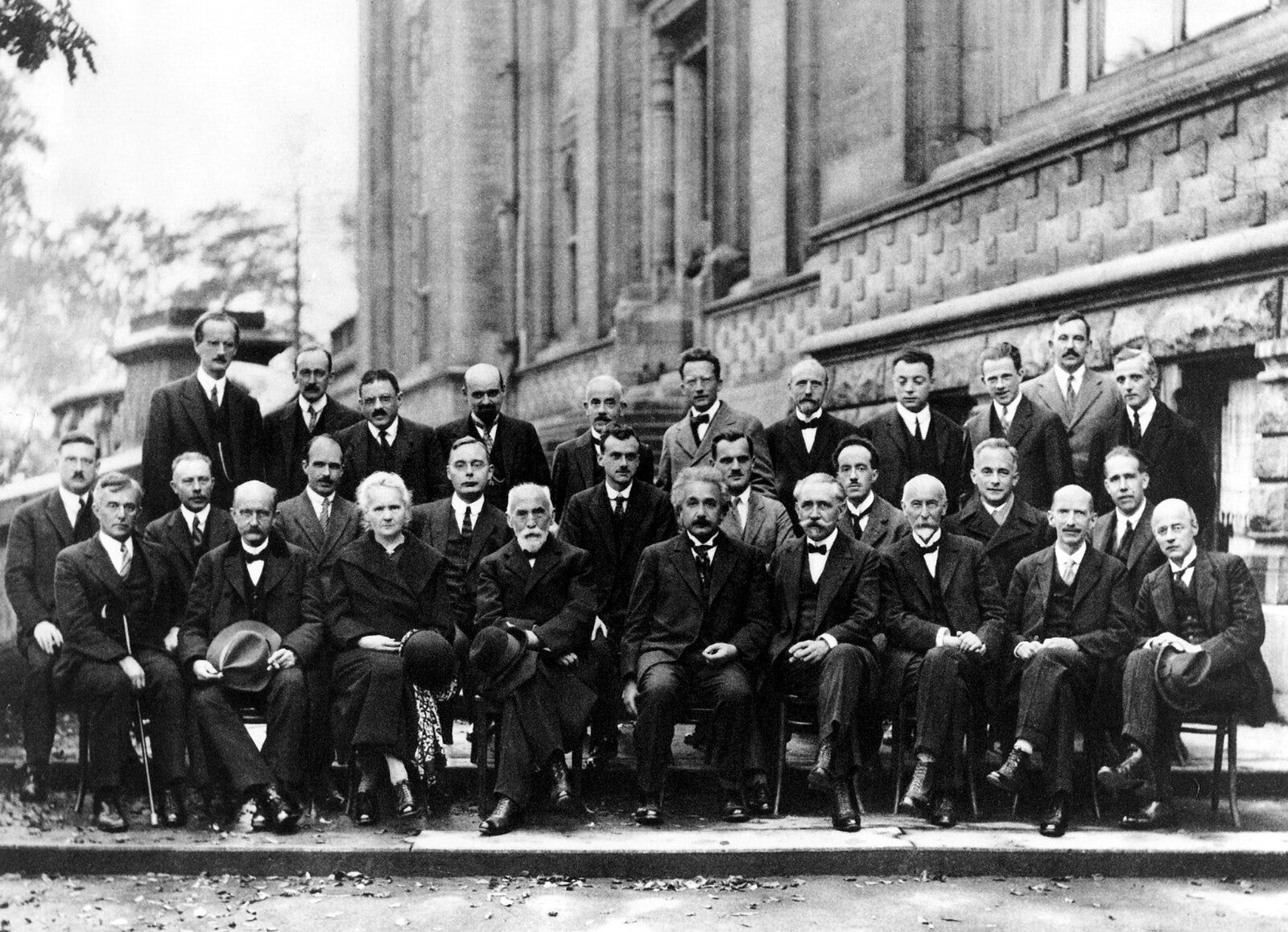
The 1927 Solvay Conference on physics became famous for multiple reasons: first, because of its adoption – by vote – of what we currently know as the predominant paradigm for physics: quantum mechanics. This is the Niels Bohr and Werner Heisenberg “Copenhagen Interpretation,” which asserts (among other things) that electrons and other subatomic particles don’t actually exist until they are measured. Prior to the act of measurement, the particles exist in “superposition” in a “wave function” that “collapses” into existence upon measurement. One other significant part of the Copenhagen Interpretation is the belief that probability is ontological: i.e. that the Universe itself is probabilistic. Einstein dissented from the Solvay Conference’s adoption of the “Copenhagen Interpretation” by famously saying (among many other things) that, “God does not play dice with the Universe.”
Over an eight-year running debate, Einstein and Bohr et al. argued over Bohr’s Copenhagen Interpretation. The Copenhagen Interpretation won out, at least according to the academy, if not in the minds of everyone who was in the affected community.
This point also needs to be stressed, because most people who have not studied quantum theory on the full technical level are incredulous when told that it does not concern itself with causes; and, indeed, it does not even recognize the notion of ‘physical reality’. The currently taught interpretation of the mathematics is due to Niels Bohr, who directed the Institute for Theoretical Physics in Copenhagen; therefore it come to be called ‘The Copenhagen interpretation’.
As Bohr stressed repeatedly in his writings and lectures, present quantum theory can only answer questions of the form: ‘If this experiment is performed, what are the possible results and their probabilities?’ It cannot, as a matter of principle, answer any question of the form: ‘What is really happening when…?’ Again, the mathematical formalism of present quantum theory, like Orwellian newspeak, does not even provide the vocabulary in which one could ask such a question…
Jaynes, E.T., “Probability Theory: the Logic of Science,” p. 328.
At this point, if you’re thinking, “Who TF is this Jaynes’ guy to be criticizing Niels Bohr and some of the greatest scientists and physicists ever?” then let me take a moment to make a long overdue introduction. Edwin T. Jaynes is not just an internet folk hero or Bayesian crank. He was, in his youth, one of four graduate students who had worked with Oppenheimer at UC Berkeley and then followed him to the east coast to the Institute for Advanced Studies (IAS) at Princeton, New Jersey.
I believe it is best to hear it from the horse’s mouth, so G. Larry Brethorst has done a wonderful job, not only in publishing “Probability Theory: The Logic of Science,” but also in putting together E.T. Jaynes’s biography page, which quotes Jaynes himself on this subject.
Between his junior and senior, year, he [E.T. Janes] worked at the Warner Institute with Drs. Gustav Martin and Marvin R. Thompson. After receiving his B. A. he intended to return to the Warner Institute for another summer, but his plans changed because of the war. From 1942 to 1944 he worked for the Sperry Gyroscope Company on Long Island helping to develop Doppler radar.
At the end of 1944, he became Ensign Jaynes, and worked at the Anacostia Naval Research Lab in Washington D. C. developing microwave systems. During his stay in the Navy he spent some time on Guam. There is one picture of him on Guam holding a machine gun. When he was discharged in 1946, he was a lieutenant (j.g.). There are two documents written by Ensign Jaynes: the first is a series of 9 lectures on solving circuit problems using Laplace and Fourier transforms; the second, is titled “Theory of Microwave Coupling Systems”. These two documents constitute the earliest known professional writings of Ed Jaynes.
Jaynes left the Navy in 1946 and headed for California. In the summer of 1946 he worked in the W. W. Hansen Laboratories of Physics at Stanford on the design of the first linear electron accelerator. At the end of the summer, he enrolled at the University of California at Berkeley, In “Disturbing The Memory” Jaynes notes:
“I first met Julian Schwinger, Robert Dicke, and Donald Hamilton during the War when we were all engaged in developing microwave theory, measurement techniques, and applications to pulsed and Doppler radar; Schwinger and Dicke at the MIT Radiation Laboratory, Hamilton and I at the Sperry Gyroscope Laboratories on Long Island. Bill Hansen (for whom the W. W. Hansen Laboratories at Stanford are now named) was running back and forth weekly, giving lectures at MIT and bringing us back the notes on the Schwinger lectures as they appeared, and I accompanied him on a few of those trips.
I first met Edward Teller when he visited Stanford in the Summer of 1946 and Hansen, Teller, and I discussed the design of the first Stanford LINAC, then underway. After some months of correspondence I first met J. R. Oppenheimer in September 1946, when I arrived at Berkeley as a beginning graduate student, to learn quantum theory from him — the result of Bill Hansen having recommended us strongly to each other. When in the Summer of 1947 Oppy moved to Princeton to take over the Institute for Advanced Study, I was one of four students that he took along. The plan was that we would enroll as graduate students at Princeton University, finish our theses under Oppy although he was not officially a Princeton University faculty member; and turn them in to Princeton (which had agreed to this somewhat unusual arrangement in view of the somewhat unusual circumstances). My thesis was to be on Quantum Electrodynamics.
But, as this writer learned from attending a year of Oppy’s lectures (1946-47) at Berkeley, and eagerly studying his printed and spoken words for several years thereafter, Oppy would never countenance any retreat from the Copenhagen position… He derived some great emotional satisfaction from just those elements of mysticism that Schrödinger and Einstein had deplored, and always wanted to make the world still more mystical, and less rational.
This desire was expressed strongly in his 1955 BBC Reith lectures (of which I still have some cherished tape recordings which recall his style of delivery at its best). Some have seen this as a fine humanist trait. I saw it increasingly as an anomaly – a basically anti-scientific attitude in a person posing as a scientist – that explains so much of the contradictions in his character.
As a more practical matter, it presented me with a problem in carrying out my plan to write a thesis under Oppy’s supervision, quite aside from the fact that his travel and other activities made it so hard to see him. Mathematically, the Feynman electromagnetic propagator made no use of those superfluous degrees of freedom; it was equally well a Green’s function for an unquantized EM field. So I wanted to reformulate electrodynamics from the ground up without using field quantization. The physical picture would be very different; but since the successful Feynman rules used so little of that physical picture anyway, I did not think that the physical predictions would be appreciably different; at least, if the idea was wrong, I wanted to understand in detail why it was wrong.
If this meant standing in contradiction with the Copenhagen interpretation, so be it; I would be delighted to see it gone anyway, for the same reason that Einstein and Schrödinger would. But I sensed that Oppy would never tolerate a grain of this; he would crush me like an eggshell if I dared to express a word of such subversive ideas. I could do a thesis with Oppy only if it was his thesis, not mine.”
Eugene Wigner became Ed’s thesis advisor in 1948.
In some ways we’ve now arrived at the reveal: Jaynes wasn’t – and isn’t – just “some guy.” His criticism of the Solvay Conference, and the Copenhagen Interpretation, is very much a part of the schism between frequentist and Bayesian understandings of what the difference is between (mere) statistics and probability in science.
We suggest, then, that those who try to justify the concept of ‘physical probability’ by pointing to quantum theory are entrapped in circular reasoning, not basically different from that noted above with coins and bridge hands. Probabilities in present quantum theory express the incompleteness of human knowledge just as truly as did those in classical statistical mechanics; only its origin is different.
In classical statistical mechanics, probability distributions represented our ignorance of the true microscopic coordinates – ignorance that was avoidable in principle but unavoidable in practice, but which did not prevent us from predicting reproducible phenomena, just because those phenomena are independent of the microscopic details.
In current quantum theory, probabilities express our own ignorance due to our failure to search for the real causes of the physical phenomena; and worse, our failure even to think seriously about the problem. This ignorance may be unavoidable in practice, but in our present state of knowledge we do not know whether it is unavoidable in principle; the ‘central dogma’ simply asserts this, and draws conclusions that belief in causes, and searching for them, is philosophically naïve. If everybody accepted this and abided by it, no further advances in understanding of physical law would ever be made; indeed, no such advance has been made since the 1927 Solvay Congress in which this mentality became solidified into physics. But it seems to us that this attitude places a premium on stupidity; to lack the ingenuity to think of a rational physical explanation is to support the supernatural view.4
These seem like rather bold declarations, but Jaynes is certainly entitled; he was in many ways one of the heirs to the original Einsteinian, deterministic universe view. Over time, Jaynes has come to stand in opposition to the frequentist “statistical” view that has come to dominate in all of the sciences. Sabine Hossenfelder, a theoretical physicist of more recent vintage, wrote in 2018 “Lost in Math: How Beauty Leads Physics Astray.” The upshot of Hossenfelder’s book is that physics, the hardest of the hard sciences, has largely abandoned empiricism in favor of mathematical elegance. Throughout the book she interviews well-regarded physicists and gets them to admit that what passes for current “state of the art” in physics is theoretical only. In fact, over the 6 years since the book was first published, you can find Hossenfelder gradually drifting closer and closer toward the Jaynes’ view in various youtube videos and lectures.5
In sum, the essence of the problem is this: statistics deals with data – ONLY. You can draw no inferences at all about the credibility of a hypothesis based upon the “significance” – or “unlikelihood” – of data, particularly based upon a comparison to some fictitious set of initinfinite trials that have never actually been done. The problem with using frequentist statistics to try to draw conclusions is – as we demonstrated with the Prosecutor’s Fallacy in Sally Clark’s case – that data, particularly when it’s in the form of frequency distributions for sample populations, can be sliced in ways that will seductively suggest to us things that we would already like to believe. And the more unusual the data, the more we convince ourselves that this is a “good enough” proxy for claiming that this anti-hypothesis we’ve assumed true (our “null”) so unlikely that… well, we must be right. Fisher and Popper used “special rules” and/or “consensus” to simply hop the logical gap to “I’m correct” when the data achieves significance. Frequentism relies upon improbable data to assert that “close enough” means the “opposite” of the null must be true – itself an incorrect logical leap.
This is why Frequentism, as practiced in the null ritual, has produced irreproducible “science” – because, ultimately, it is lazy science using statistics as a mask for what amounts to “I’m correct because six sigma, bruh.” It’s science according to the characters in a Bret Easton Ellis novel. The predictive power of a hypothesis – the hallmark of real science – not only distinguishes between conjecture, hypothesis, theory, and law specifically by the strength of their predictive power, it is the demarcation between science and non-science. In frequentist “science”, predictive strength is replaced as method of validation by (a) publication in a journal, of (b) data that is statistically unusual, (c) using a fabricated, hybrid-statistic by non-mathematicians (the null ritual) of (d) a conjecture that my peers agree with.
So, why did I do all of this by way of background? Well, first, because I wanted to build you up to seeing why I don’t believe the Copenhagen Interpretation of quantum theory – I do not believe God plays dice either – and to declare my fealty to the Laplace-Jeffries-Einstein-Polya-Jaynes line of reasoning that does not believe probability inheres in objects, either. But second, because the frequentist view is – of course – the one that our Supreme Court adopted and reified first in the 1920s (of course) and then updated in the 1960s and 1980s. We’ll take a look at the Court’s view of science from Frye to Daubert and Kumho Tire and see what it means for litigants and lawyers.
- In David Stove’s “Scientific Irrationalism: the Birth of a Postmodern Cult,” he provides chapter and verse of cases where Sir Karl Popper, when faced with this problem, simply declared the need for “special rules” that would come from “consensus” among professionals. How utterly convenient for academic bullies like Fisher and Popper that science would somehow come down to votes by faculty – consensus – to determine whether someone was “right” or “wrong”. See, e.g., David Stove, “Scientific Irrationalism: the Birth of a Postmodern Cult,” pp. ↩︎
- Our good friend William Briggs explains – and vilifies – the null ritual in many ways on his blog, but here’s just one explanation of how wrong Popper, Fisher, and their intellectual descendants are via David Stove’s incisive writing. ↩︎
- https://knowyourmeme.com/memes/profit – except in scientistic publishing, it works. “Science” publications profit massively from a cartel-like monopoly on the work of authors who are beholden to this entire system. ↩︎
- Jaynes, “Probability Theory: The Logic of Science,” pp. 328-329. ↩︎
- See, for example, “Why Einstein was a Determinist.” ↩︎

Exciting topic!
Are these “frequentists” who have secret desires that you can (telepathically?) discern in the room with us right now?
LOL. No, but they’re published in papers everywhere proclaiming the “proof” of their “study” because p=.0025!
The frequentist mathematicians who can be cornered and know better will deny that the probability of a hypothesis has any meaning at all. They also believe that falsification is science and probability inheres in objects, just like quantum theory does.
“Bernoulli’s Fallacy” covers it quite well from a mathematician who came from that world; many other “reformed” frequentists can report the same belief system as part of what’s necessary to exist in academe.
And of course, David Stove goes chapter and verse through Popper, Kuhn, Lakatos, and Feyerabend in “Scientific Irrationalism,” as well as providing a proof refuting Hume’s inductive skepticism.
lol I am enjoying the series on and off… alternating between breaking my brain here and breaking my brain on a programming language implementation tutorial.
And I have to pack for travel tomorrow. 🙄
Which language?
A custom language. I’ve always wanted to play with this stuff but never found a decent intro but this one gets good reviews so I might play along.
Ah, that’s cool, albeit retirement-level pursuit for me, sadly.
A video that neatly explains the differences between math, science, and engineering:
https://www.youtube.com/watch?v=_ivqWN4L3zU
key point: engineering is about using rules of thumb to solve complex problems when information and understanding is incomplete
GREAT VIDEO, DERPY!
I think the difference between Mr. Hammack and I is largely in terminology. But I’m saying much of what he says in that video on arches except about law and (by proxy) all human knowledge (i.e. conditional propositions), rather than physical problems. He goes right to where I’ve been in the last sentence when he talks about engineering as managing uncertainty.
That is, indeed, a great video.
Just bought his book.
Yeah, fantastic.
I always scoffed at my job title “software engineer” but well, I just build shit that works and that’s good enough for me.
I will pile on. Interesting Article and Great Video!
I was tempted to write another screed about the Army’s Basic Leader Course until I found this gem:
https://www.reddit.com/r/army/comments/arxqgo/why_is_it_impossible_to_fail_blc/
I was told there’d be no thinking!
Heady stuff for a midwit like me, I look forward to future installments.
So, I’ve been assured by many that the goal of dropping these bombs on Iran was to destroy their nuclear program. Now it’s being leaked that the actual assessment is that Iran’s nuclear facilities remain intact despite what Trump said. Trump knew this when he declared a ceasefire. As did, I’m sure, Israel.
Now, I’m no genius (actually kind of am, and not just the Firsting kind), but that’s rather peculiar to me. If the goal was really to stop them from getting a bomb, no peace could be made before those facilities were destroyed. You could in fact argue that leaving them intact only emboldens Iran to keep developing. That they are more dangerous than ever now.
Israel had like half a dozen motives besides nukes to attack and Netanyahu has lied about the state of the Iranian nuclear program many times in the past. Combine that with what Gabbard said our own assessment was (they weren’t even close), and anyone with a shred of integrity should really be questioning the bullshit they’ve been spoonfed by the Trump administration and Israel.
You should have been doing that in the first place seeing as how we’ve gotten like 5 different statements on the state of their nuclear program in a month’s time.
There’s a Cappy Army vid where he goes,through the BDA. Admittedly, he’s not anonymous source leaking that the USAF is incompetent and Drumph is Bibi’s cockholster, so you might not believe him.
I’ll believe the Pentagon’s own assessment of the damage on an underground facility combined with Trump’s own refusal to even deny the leak is true.
If it wasn’t true, that’s the first thing that would have come out of Trump’s mouth. Not trashing the media for reporting on it.
You’ll believe what you want to believe.
And Covid came from a wet market.
That’s not even an apples to oranges comparison. That’s just dumb.
Could the leaks be bullshit? Sure. Then it begs the question as to why Trump didn’t deny it.
If the internal evidence they have suggests failure, then we don’t have anything better to go on.
What’s become painfully obvious to me here is that there is a massive blind-spot around here for Trump because some of you voted for him and particularly with regards to Israel.
But no one seems interested in debating my main point which is that if they knew the attack was a failure or believed it was, it would make no sense for them to declare a ceasefire if the real point was to get rid of those facilities.
What’s dumb is saying that one anonymous leak from one of the 18 agencies involved in the assessment speaks for everybody. This supposedly came from the DIA, who also said that Covid came from a wet market. What’s dumb is being an asshat and trashing other people for no other reason than they have a different opinion. Quit being dumb.
There’s not really much supposedly to this. The White House has confirmed that the report is real, only attacking the source for leaking it and the media for reporting on it.
Iran has publicly stated they removed their enriched uranium from those sites before they could be attacked. The Pentagon is now backing that claim up.
What besides the proclamations of Trump leads anyone to believe those facilities are actually destroyed right now? And I don’t want to hear the opinion of a Youtuber no matter how knowledgeable he may be on military affairs because he sure as shit does not know the specs of that site.
I hear Bro is an anti-semite after all.
My beliefs lie somewhere between this and the cocksucking that has been playing 24/7 on Fox News.
IOW I have no fucking clue.
IOW I have no fucking clue.
Hey Diogenes, I found one for you, come see.
The photos show two precise looking clusters of penetration. For those to be effective: There must have been great intelligence on the layout of the facility underneath that ridge and the bombs must have been close to infrastructure that was near enough to the surface to be reachable.
So, the mission could have been a great success or a total failure. No way to know by looking from the outside. I assume they need inside sources to confirm what level of damage was achieved.
I don’t expect to ever see a realistic assessment of the damage in the public domain.
I don’t expect to ever see a realistic assessment of the damage in the public domain.
This.
I don’t pretend to be able to analyze satellite images of an underground nuclear facility that has just been bombed with bunker busters. Hence my deferral to the people who get paid for such things.
But Not Adahn has some Youtuber he swears by and who has no access to intelligence on the site so there’s that.
But I”M the one who believes what I want to believe here.
“Hence my deferral to the people who get paid for such things.”
I’m, legitimately, unclear who you’re referring to here.
I’m going to refer to the Pentagon and the DNI, comparisons to covid wet market reports be damned (which was the assessment of our entire intelligence community at least publicly – likely for highly political reasons to include that we helped fund the god damn gain of function research that created covid).
Maybe the Pentagon’s assessment is wrong. But there sure as shit is no evidence anyone here possesses that indicates the opposite is actually true.
Also, per CNN here:
Yea, overwhelming smashing success. We bought two years on a nuclear program which our head of intelligence said wasn’t even close and which Netanyahu himself said was a year away just about two weeks ago now when asked.
How many different versions of the story do people need to hear before their bullshit meters go off?
How to put this? Doing BDAs was my job at NSA. You don’t need pictures from satellites to get an accurate one.
Hint: loose lips sink ships (and subs)
https://en.wikipedia.org/wiki/Andrew_J._May
***
May was responsible for the release of highly confidential military information during World War II known as the May Incident.[6] U.S. submarines had been conducting a successful undersea war against Japanese shipping during World War II, frequently escaping their anti-submarine depth charge attacks.[6][7] May revealed the deficiencies of Japanese depth-charge tactics in a press conference held in June 1943 on his return from a war zone junket.[6][7] At this press conference, he revealed the highly sensitive fact that American submarines had a high survival rate because Japanese depth charges were exploding at too shallow a depth.[6][7] Various press associations sent this leaked news story over their wires and many newspapers published it, including one in Honolulu, Hawaii.[6][7]
After the news became public, Japanese naval antisubmarine forces began adjusting their depth charges to explode at a greater depth.[6][7] Vice Admiral Charles A. Lockwood, commander of the U.S. submarine fleet in the Pacific, estimated that May’s security breach cost the United States Navy as many as 10 submarines and 800 crewmen killed in action.[6][7] He said, “I hear Congressman May said the Jap depth charges are not set deep enough. He would be pleased to know that the Japs set them deeper now.”
***
Joy Behar tried to top his feat recently:
https://www.youtube.com/watch?v=a6xxtbzKwy4
oops, right Behar link here:
https://www.youtube.com/watch?v=3UtyyB7zWAw
Hence my deferral to the people who get paid for such things.
The problem is those people are paid to reach conclusions satisfactory to the people paying them.
I can conjure up plenty of reasons for the Pentagon to lie or slant their coverage of this. But here’s my problem:
1. There’s really no evidence of the counter point being true at this stage.
2. They are confirming what Iran has already stated themselves.
3. If I dare to suggest that Trump and Netanyahu had ulterior motives beyond what they’ve publicly stated, I get called an anti-Semite or just a conspiracy theorist and dismissed. The pro-Israel/pro-Trump crowd here (which I’m normally accused of being part of) on the other hand can just nonchalantly accuse a Pentagon intelligence assessment of being bullshit without going into any reason as to why it would be. There’s explanations, a number of which are conspiratorial in nature. Or they could just be wrong, but circle this back to point #1.
4. If this was Biden, I don’t think the same benefit of the doubt would be given around here. I’m not trying to play mind reader, but I’ve been around long enough to strongly suspect this is the case.
We all have our biases. Every party involved lies here pretty much professionally. But people are far more willing to believe the comfy little justification for all this than I think they otherwise would be.
It’s like a woman whose abuser promises to change and she takes him back again.
“I can conjure up plenty of reasons for the Pentagon to lie or slant their coverage of this”
Just so I’m clear – are you going off something the Pentagon actually stated? Or just “reports”?
Either way they’re probably bullshit but reporting anonymous sources as “the Pentagon” is not the most trustworthy thing I can imagine.
The assessment from the DNI leaked to the media today/tonight. There are supposedly multiple anonymous sources for it.
You can call bullshit, but the White House admitted the report is true. They simply dismissed it and called the media irresponsible for reporting on it while trashing the leaker.
DNI != The Pentagon, right?
The leakers want you to believe X.
Is X true? “Who the fuck knows?”
All government statements, especially “leaks” are suspect.
DNI = Defense Intelligence Agency, the Pentagon’s intelligence apparatus.
They very well could be lying, but I’ve outlined this point already. There’s no real evidence that the strike was a success, and Israeli intelligence (at least according to CNN) believes that the facility remains intact, as well. Only surface level damage, but this somehow amounted to a 2 year setback for Iran’s nuclear program.
Everything is propaganda at the end of the day.
I had my three semesters of physics, plus optics, and electromagnetic theory. The probabilities were manageable. Then I graduated and went off to write code.
I never got to the level of counting angels on the head of a pin. And I don’t want to start now. 😉
Trying to follow along, but gist of this is just out of grasp.
The gist of it all is (1) probability is in our head – it’s a measure of the state of our ignorance or knowledge of a given phenomenon or system. Corollary 1 – Dice don’t have one-in-sixness; that is a mathematical construct (a limit function) because no one has actually ever rolled dice an infinite number of times. Any throw of a die obeys the same laws of physics as the throw of a baseball or a paper airplane do, not the “laws” of the limit function. (It’s what Jaynes calls the mind-projection fallacy).
(2) Science is the objective branch of human knowledge, siloed in models that forecast a present fact onto a future, unmapped fact via a prediction. We call these predictions “hypotheses” and rank them by their predictive strength from conjecture through law.
Corollary 2A- Falsification is NOT the demarcation b/w science and non-science. Falsification is necessary for something to be a “meaningful proposition” and by that I mean a claim that is at least amenable to proof one way or other by a certain quantum of evidence, but that is nowhere close to being enough to make something science.
Corollary 2B – General acceptance or consensus also do not make anything “science” or “not science”. We don’t vote on science.
Misunderstanding this has been the root of much of the fuckery that we are subject to in health sciences and now it’s even leaked into the hard sciences like engineering and physics. We have reified ignorance and claimed the universe is indeterminate because reasons. And that’s why we haven’t done anything deeply impactful in almost a century.
Mostly agree with 2, 2A, and 2B.
Nobody has ever rolled dice an infinite number of times
No-one has jumped off a 100 story building an infinite number of times either, but that doesn’t mean I’m not going to postulate, with a very high degree of certainty, that I will make a large splat 100 stories down if I jump off a 100 story building; I might even model it mathematically as a delta function at 1! Now we have a well developed theory of gravity that formalizes why that particular outcome will obtain. That well developed theory was, in part, developed by the frequent observation of the results of things falling (including planets falling around the sun).
Dice follow the same physical laws as a baseball or airplane – indeed. And that’s why you have a roughly 1/6 chance of seeing a given number on any given throw, modulo irregularities in the die that may interact with the local conditions slightly differently, much like the initial conditions of tossing myself from a tall building might affect exactly which part of me goes splat first, but splat I will. I simply don’t understand this “no ones ever rolled a dies an infinite number times” – that’s just a tautology. The ‘limit function’ is a mathematical model for the *observed* behavior of repeated dice throws in the context of the micro and macro physics of the interactions of physical bodies. I know of no-one who considers that dice have a 1-over-sixness property – whatever that means to have this ‘Platonic’ property – simply that the interaction of that particular geometric construct with it’s environment, given what we know about physical laws (and considering that what we know about physical laws is partly derived from repeated observations of systems – chicken v. egg), will end up with results that closely follow a flat distribution. One might say that 1-over-six ‘property’ inheres from the underlying geometric and physical reality – but that’s very different from some inherent 1-over-six property, something that no-one I know actually claims, largely because it’s meaningless.
As an aside about p-values from above: p-value tells us anything at all about the strength of the hypothesis under consideration – it does not – It’s really a case of GIGO. All a p-value gives you is an idea of how likely an observation would arise by chance subject to your knowledge of true distributions. Nothing more, nothing less. It tells you nothing about the strength of your hypothesis. That this tool can be hacked, misinterpreted (whether intentionally or not), misrepresented, over-interpreted, etc etc. says nothing about the validity of the tool nor its usefulness in some situations. Good science requires good training and holding oneself – and others – to a rigorous standard consistently. Without doing at least that, arguments about the tool are largely irrelevant – your favorite tool or interpretive framework will very rapidly be corrupted as well.
Why the hell is there an editorial section in a statistics journal? You opinion matters fuck all in the domain of mathematics.
Unless your claim is statistics isn’t mathematics…
My claim is that statistics isn’t science, but unfortunately academic science got captured by statisticians in the early to mid 1900s and our entire understanding of how the universe works has become enslaved to mathematical models completely disconnected from validation (by reality).
Ozy, that rant was not directed at you. It was directed at the fact that there’s an editorial section in a statistics journal.
Got it. Misthreaded below with Evan.
Cheers.
I can’t now but will read this in depth later.
Thank you for this series. It makes my mind both wander in itself but also focus on how we mostly agree. A fun place to take my mind, using ‘understandable’ examples I’ve never lived, especially when well-written and experienced by the author.
Bravo x ∞. Keep it up, cheers, with my hat off.
Thank you, Evan!
Oh, I got that. No worries.
I think the entire Israel-Iran thing is completely unknowable unless you’ve got some serious insider access, and even then I would suspect no one will ever know the “real” story of WTF we just went through. Like everything nowadays, it’s only value seems to be in its use as a rorschach test for political junkies to help divide THEM and OTHER THEM from US and OTHER US.
None of this followed any prior pattern because we are now so fucking far removed from anything that looks remotely like constitutional governance that there simply isn’t a “norm” any more against which any of this can be measured. The Media’s fuckery has also left the public with no trusted source of something even pretending to get at facts or some consistent willingness to dig to get at truth, so we’re all just stuck with opinions and more opinions and yet more opinions from people thrice removed from anything like “knowledge” about any subject.
My version o;f reality doesn’t have to be true for the official narrative to be bullshit would be my main point.
We’ve gotten at least five different versions of reality on the state of Iran’s nuclear program in about a month’s time from Israel and Trump’s cabinet. That stinks to high heaven.
That lack of skepticism and willingness to accept the official narrative that this was just about a nuclear program given the timing is what I find jarring.
I think your suspicions have a very sound basis. None of this smells right at all – not from Israel, the USA, or Iran.
I rate it as… “they’re *all* fucking lying”! The problem with that assessment is that it allows for an infinite number of interpretations to be offered to explain what those lies mean – some of which might even be distant cousins of reality. 😉
I’m on the “who the fuck knows?” train.
If Iran is “back in business” in two years? “Who the fuck knows?”
If they’re not? “Who the fuck knows?”
We’re lied to about everything at this point.
I’m trying to be stoic about it.
All of this.
Everything at this point is a big ¯\_(ツ)_/¯.
If the stakes weren’t so high and/or it was really over, I’d agree.
But I don’t trust Israel is done unless they’ve been given some behind the scenes promises or guarantees of something. I don’t know what that something is exactly, though I have my guesses based on my beliefs as to why this all really happened.
It aint about the nukes. I don’t think Iran was any closer on that front that they had been at any point in the last two decades. At least not particularly so. But Netanyahu said it and then Trump jumped on the bandwagon once the bombs started to be dropped so I’m just supposed to go along nicely.
Regardless, I’ll shut the fuck up about this for tonight because Ozy’s content is a good read and I’ve distracted from it enough.
“If the stakes weren’t so high and/or it was really over, I’d agree.”
None of that changes the “who the fuck knows?” And our need to be stoic.
We have zero, literally zero, control over these events.
(Unless you’re some Fed. *gives Bro the stink eye*)
I’m hardly panicking, despite what it may seem like. I made a bet with my brother who was panicking that this would not escalate into all out war and that it would fizzle out. But because Iran wouldn’t bother to respond, and it would if anything do what they’ve always done – rely on their proxies throughout the region to do their dirty work for them.
So, I was mostly right, though I didn’t even think the US would join in. They did, but I still stuck to my guns on the above. And Iran proved me right in my view.
Well, it will be obvious if they test a nuke, as I expect them to at some point. It’s this all over again:
https://www.latimes.com/archives/la-xpm-1998-sep-27-mn-26986-story.html
***
Amid the utmost secrecy, top aides of President Lyndon B. Johnson agonized during the early months of 1964 over a single, preoccupying national security issue: Should the United States bomb China to stop it from becoming a nuclear power?
“I’m for this,” scrawled Johnson’s national security advisor, McGeorge Bundy, on one memo about a possible preemptive strike that might cripple Chinese nuclear installations.
The Joint Chiefs of Staff studied options for military action, including the use of U.S. nuclear weapons. The CIA plotted covert action against China’s test facilities at Lop Nor. American officials even sounded out the Soviet Union about collaborating to stop China from getting the bomb.
***
But they got it, and the world did not end despite much wailing and gnashing of teeth.
OnlY Our ToPpE MEn CaN HaNdlE tHE ReSponsiBiLiTY!!
No but they’re more serious about the “Death to America” thing than, say, Iran ever was.
Not that I think they’re quite there yet, but America anguishing over nonsense issues like trannies and reparations and klimate does not fill me with confidence.
Too much thinking, going disc golfing,
Enjoy and the Tall Cans thing,
There was much pants-shitting and do-something-ism when China got the bomb, and when they did, the world didn’t end, the USSR did, and China became our #3 trading partner, #4 if you count the EU as a country.
There was even more pants-shitting about North Korea, and the world didn’t end either, though the status quo hardly changed.
Iran wouldn’t be full of old fart mullahs if they actually believed all that jazz about the glory of martyrdom and the 12th imam.
It reminds of a story from Tibet where a nervous monk asks a lama about all the hells, and the lama says “eh, those are just stories to get the common people to behave.”
China trades with us with one hand, steals our intelligence with another, and plots our destruction with a third.
Yes, but they also starved to death by the millions in the 60s and lost a war to Vietnam in 1979.
I am not worried about them taking over. Visual aid:
https://youtu.be/ZZzhESKHwJg?si=tjBcV9RL0Dkmofxw&t=445
lol But they’re not all crackpots.
I think we need to take the threat seriously.
Stumbled across a patch of sensitive briars on my walk to KFC today. They fold their leaves together when you touch them:
https://www.youtube.com/watch?v=sbmNZM-NwAI
They find the “b-word” offensive and prefer to be called Kentuckians, if you please./SW Ohioan
Maybe Khamenei will be unmasked Scooby Doo style and be revealed to be a Boeing executive.
“That’s right, I scammed them into buying my bombs, and I would have gotten away with it too if it weren’t for you meddling kids!”
“Rooby rooby Rubiat ruv Ral-Rhayyammmm!”
Has anyone checked on John Bolton? I’m sure his been beating his meat like it owes him money all week.
https://www.youtube.com/watch?v=O7VfeVYFl1s
*he’s been
chyron from the video – Iran foreign minister says Bolton & key US Allies are trying to push Trump into a conflict
The video is from 2019.
Looks like the guy was right.
Cuomo sent his mayoral candidacy to a nursing home.
Holy fucking shit LOL.
You earned it, NYC.
Can we expell downstate from the Union?
Revoke their ability to self-rule, since they clearly can’t handle it.
I’m plotting exit strategies myself but it ain’t easy.
But this state is a loony-bin.
Move somewhere with really shitty weather – Alaska, Wyoming, Nevada, Texas, Florida, North Dakota.
To paraphrase Milton’s Satan, there at least we shall be free.
I know and that pisses me off.
The hot and humid locales are a gigantic NO but some of the rest… hm.
I feel for you, rhy. Same situation here.
Mamdani is a perfect example of why naturalized citizens should inelegible for any elective office.
I don’t know and don’t particularly care on the Israel Iran thing. I hope they both lose, I guess.
Anyway, if this is true, it’s hilarious:
https://x.com/bennyjohnson/status/1937682638443028711
I was going to ask if anyone believed there was an actual button within arm’s reach that just launches nukes… then I remembered how dumb people are.
This video game cutscene is somewhat accurate regarding nukes:
https://www.youtube.com/watch?v=fnd0qg4I_MM
We used to laugh our asses off at this as kids, speaking of poorly placed buttons:
https://www.youtube.com/watch?v=pPKymEC_Hss
When the launch order comes, eventually leads to 2 guys in a missile silo turning keys:
https://www.youtube.com/watch?v=FVZmFISzqwY
I saw this at silo-turned museum near Tucson. Before that, I broke into and poked around in an abandoned Atlas missile base near Vernon, Tx.
Titan missiles kinda sucked, but you can scuba dive in one of the abandoned silos:
https://www.youtube.com/watch?v=d3dLTP1RNQQ
***
The bare sphere critical mass is approximately 52 kg.
…
The use of a neutron reflector can significantly reduce the critical mass required, allowing for as little as 15 kg of Uranium-235 to achieve criticality.
***
(52,000 g)/(19.1 g/cm^3) = 2736 cm^3
r = (0.75*2376 cm^3)^(1/3) = 12 cm
A 52 kg sphere of uranium has a radius of about 12 cm or about 5 inches.
For the second case, it is about 8 cm or 3.5 inches.
Objects that size are easy to hide.
For plutonium, a sphere of critical mass has a radius of about 7 cm or 2.5 inches.
For a Little Boy (shotgun design)
***
The projectile was a hollow cylinder with 60% of the total mass (38.5 kilograms [85 lb]). It consisted of a stack of nine uranium rings, each 6.25 inches (159 mm) in diameter with a 4-inch (100 mm) bore in the center, and a total length of 7 inches (180 mm), pressed together into the front end of a thin-walled projectile 16.25 inches (413 mm) long. Filling in the remainder of the space behind these rings in the projectile was a tungsten carbide disc with a steel back. At ignition, the projectile slug was pushed 42 inches (1,100 mm) along the 72-inch-long (1,800 mm), 6.5-inch-wide (170 mm) smooth-bore gun barrel. The slug “insert” was a 4-inch cylinder, 7 inches in length with a 1-inch (25 mm) axial hole. The slug comprised 40% of the total fissile mass (25.6 kilograms or 56 pounds).
***
I wouldn’t be surprised if the Iranians have almost assembled nukes scattered in pieces here and there. The nuclear complexes were sacrificial lambs.
It occurred to me just now that some poor IRGC slobs have uranium shoved up their poop chutes kind of like the way Pakistan drives its nukes around at random in vans. Well, they’ll probably get a medal for someday.
https://www.wearethemighty.com/articles/this-is-why-pakistan-drives-its-nukes-around-in-delivery-vans/
Do you still get the 72 virgins if you die from radiation or heavy metal poisoning muling nukes?
Nope.
WW2 America Battle Hymn:
https://www.youtube.com/watch?v=kR7HPQM0Jgg
Iwo Jima assault:
https://www.youtube.com/watch?v=pGg-pmV1P5o
I take solace in the hope that such things are unlikely to ever happen again.
Hey Glibs! Get your Glib asses outta bed and get on Glibbing.
🙋♂️🥾🦡
https://www.youtube.com/watch?v=CzIq6cEkRSk
🎶🎶
Does This plant look happy? I’ve been thinking so, but I don’t want to miss warning signs. The bent stem on the leaf in the profile image is from me when I tied the main stem to the stake. I had a hard time getting in there to wrap the velcro around it.
Use twist ties is my advice. Looks healthy.
Amazon sells big spools. One will last you a long time.
I call it Velcro Because that’s the brand name.
Have you tried asking it if it’s happy?
I’m afraid I’m not on speaking terms with my plants.
It looks fine.
You don’t need to stake peppers that much, and don’t do it so tightly.
It’s not tight, there’s plenty of slack, and easy to relax further if needed. I tied it twice because I’d let it lay down for too long and I had two bends to coax out of it.
Is that the final home for the plant or will you be moving to a bigger pot?
I’m hoping it’s the final home. The cultivar in question isn’t supposed to grow past 2 feet tall. I don’t really have anywhere to put a bigger pot.
It’s 6 and the temperature is 77. Now if it would just hold there.
Weather Fairy: 77 you say? *switches to Celcius*
Mornin’, reprobates. I’d have a better chance of understanding Ozy’s musings had I not
droppedbeen kicked out of college in my freshman year. Still enjoying the series, though.Going to a community college and commuter university limited the opportunities to get kicked out.
suh’ fam
whats goody
Not as hot today, but the universe has delivered me a new kind of hell- 2 days at the poop incinerator.
Indoors, working on top of the units, its going to be a humid 105-110 degrees.
😱
If the poop that is being incinerated started out as Indian food is it a fire shit, shit fire?
Happy birthday to me. 74 now, and feeling it.
The appropriate song.
Happy Birthday, Beau.
Happy Birthday, Beau. Now things will begin to go downhill.
You ain’t seen nuthin’ yet!
Based on the last 7 months, the descent is well (um, fully) underway.
At least the hernia surgery last Thursday went well. I’m mostly off painkillers — Tylenol in the morning and at bedtime seems to suffice. Much better than I expected 😉
Happy Birthday, Beau! 🎂🎉🥳🍾🎊💃🏼🕺🏼👯♀️👯♂️ And good morning, U, homey, Roat, ‘patzie, Sean, and Ted’S.!
Morning, GT. how goes?
So far, so good… but I haven’t stepped outside yet. 🥵 79 degrees per my phone, so we’ll see how long it stays reasonably comfortable at Tranq Base.
How are you?
Mornin’
I’m in the office today. My sleep schedule is still 5pm-midnight, which isn’t ideal, but I can make it through the workday.
Good morning, Jarfy! I saw you challenging someone for another big bet. Did you get any takers? (I’m not touching anything to do with this Israel/Iran thing!)
Nope. I’m mostly just being annoyed at the hyperbole (not you Hyperbole) in both directions about the whole thing. It feels like we are dividing into two camps:
1. OMG Trump is an Israeli thrall and we’re going to turn into a dictatorship to invade Iran, kill millions and trigger WWIII because of this massive betrayal of all decency
2. OMG Iran was 7 and a half seconds from building a doomsday device that would immediately kill all Christians, Jews, puppies and kittens and usher in the thousand year reign of the dark overlord!
and I’m sitting her looking at what actually happened and thinking , we dropped a handful of bombs on a country that spends most of its time being the biggest asshole it can. Hell we do that all the time, at least this time we picked an asshole to bomb. Why is everything so fraught?
A couple days ago I said “It ain’t over yet”
A lifetime of watching pols has been discouraging
Trump is neither an isolationist nor an interventionist. He bombed countries during his first term, and didn’t get dragged into another war.
Clinton bombed an aspirin factory over a blowjob. And nothing else happened.
U, I hope you can ease yourself back into a sleep schedule that’s a little less nocturnal. 🦉
🥱🤞😴
Relevant song:
https://m.youtube.com/watch?v=lE6sme7SHj8
Also relevant:
https://m.youtube.com/watch?v=Tmo0s2ynZHI
Happy Birthday
My contribution (from the 80s):
https://www.youtube.com/watch?v=6t1vaF50Ks0
more 80s
Thank you all! It’s much appreciated!
Happy birthday! I will share the traditional song of my people in celebration!
and the original
Happy birthday!
sorry to step on your birthday with my grumpiness Beau, many happy returns!
No worries — grumpy is kind of my natural rest state 😉
HBD 🙂
HBD!!
It’s funny – I dislike “The Scream” as a painting. I think it’s terrible. But I find a bunch of the scream Emojis endlessly amusing, all of which homage that painting.
High in the mid 60s predicted for today and tomorrow.
So far no skeeters but the deer flies are not so dear. Only a few though.
Bees can take the day off, a little rain predicted.