
Modern Medical Mathematical Malpractice

What’s an Order of Magnitude Between Friends?
Time to discuss an insidious and systemic problem through the lens of two case studies. Along the way, we’ll learn & discuss the necessary math to see whence this problem comes and where the errors lie. It bears note that these examples are extraordinarily common use cases of conditional probabilities in western medicine, occurring across the world every day. Indeed, at the center of the justifications for Covid-19 lockdowns, and many other government human rights and personal sovereignty violations that we just lived through, was the willful misuse of medical testing diagnostics and statistical inferences from those tools.1
A. An Epidemic of Diagnostics
If you go to the Harvard Health website, here, you can read this:
From biopsies to bypass surgery, you’ll find information below on more than 110 tests and procedures. Designed to remove anxiety and uncertainty, these concise reports explain the purpose, how to prep, how it’s done, the risks, follow-up, and helpful outside links.
(my emphasis on uncertainty).
Harvard Health’s website by no means covers all of the possible medical diagnostics available; these are just the ones inexpensive enough that the medical authorities have deemed usable on the rubes. On the page are more than a hundred common diagnostics, tests, and procedures that (one can’t help but notice) are going to “remove anxiety” that comes from “uncertainty.” Not coincidentally, the California Psychics website – indeed, its very tagline – promises its clients the very same thing as Harvard Health’s diagnostics website, except in reverse image: California Psychics will “remove [your] anxiety” by replacing it with “the Joy of Certainty.” (Go ahead and laugh it up for the moment at the silly Harvard, er, I mean, psychics).
In 1978, Casscells et al published a small but important study2 showing that the majority of physicians, house officers, and students overestimated the positive predictive value (PPV) of a laboratory test result using prevalence and false positive rate.
“Medicine’s Uncomfortable Relationship with Math: Calculating Positive Predictive Value,” Manrai, A. et al, JAMA Intern Med. 2014 June; 174(6): 991–993.
Let’s not skip the details because some of you can only be convinced by brute force. How much did they overestimate PPV by… a little? No, by a LOT. By a life-altering lot. There’s a big difference, a life-changing difference, between a 2% chance of having a serious disease and a 95% chance of having a disease. In 1978, Dr. Casscells had a hypothesis – that doctors didn’t understand the math necessary to give accurate advice about the results of medical diagnostics tests – so he and a few colleagues asked 20 physicians, 20 residents, and 20 medical students at Harvard teaching hospitals the following question:
If a test to detect a disease whose prevalence is 1/1000 has a false positive rate of 5%, what is the chance that a person found to have a positive result actually has the disease, assuming that you know nothing about the person’s symptoms or signs?
This is a math problem with a very definite, single, correct answer that can be derived using the eponymous theorem of our old friend Thomas Bayes. We’ll do the math below, but the important part isn’t the number itself: the important point is that out of 60 doctors, residents, and med students at Haahhvahd teaching hospitals only 11/60 (18%) got the correct answer. B-b-but this is just a… uh…. a statistical anomaly… Harvard has only the Toppest of Toppe Medical Men and WoMen!
In July 2013, the same question was asked of a convenience sample of physicians, residents, and medical students (n = 61) at a Boston area hospital with 23% answering correctly.
“The Inability to Calculate Predictive Values: an Old Problem that Has Not Gone Away,” Stovitz, S., Medical Science Educator (2020) 30:685–688.
For those who like odds, this means that if you get a medical test in a Boston hospital, you’ve got slightly less than a 1 in 4 chance that your doctor can interpret the results correctly. And just so it doesn’t seem like I’m picking on the profession, let me pile on with the details. (Don’t worry, it only gets worse as you delve deeper). In his 2020 paper, Dr. Steven Stovitz reviews some of the prior literature, dating back to the 1960s, which strongly suggests that the majority of the medical profession has no fucking idea at all about the mathematics necessary to calculate the positive predictive value of the medical tests and diagnostics that they’re using.
The problem isn’t simply that only 11/60 or 14/61 got the correct answer, it’s that the other 49 or 44 docs were wildly wrong about what the test actually meant for the patient’s health by at least an order of magnitude. To be precise, the correct answer is a positive predictive value (PPV) of 1.96% – which is to say that the patient in the hypothetical problem had just less than a 2% chance of “having” whatever condition the test was designed to discover… but in the 1978 Casscells study, 27/60 (45%) of the doctors and residents said the PPV was “95%.”
Let’s just sit with this for a minute: 11/60 docs said correctly that the test results meant the patient had a 2% “chance” or “likelihood” (but for those of us in the know, it’s “probability”) of having the disease being tested; 27 of the remaining 49 would have told the patient that they’re probability of having the disease was 95% – that’s 48 times more likely than the reality. In the 2013 rerun of the study (with N=61), the Manrai study got… the same number, 27, who said that the PPV was 95%.
B-b-but it’s different if you ask doctors about tests in their particular spesh-ee-al-i-tee!
In a 2007 medical education seminar, Prof. Gird Gigerenzer of the Max Planck Institute was teaching 160 gynecologists. He gave them a similar question to calculate PPV for a hypothetical patient’s mammogram results. He gave the disease prevalence for breast cancer in women (1%), the sensitivity of the test (90%), and a 9% false positive rate and then asked: if a woman tests positive, what are the chances that she actually has the disease? He then provided 4 possible answers A-D in multiple choice format. The correct answer was C (“out of every 10 women who test positive, about 1 has breast cancer.”) 34 out of 160 (a paltry 21%) got the correct answer, less than what “random guessing” would produce (about 1 in 4, right, frequentists?)
B. Math Alert for Those Who Couldn’t Pass O-Chem! (Irony alert for doctors).3
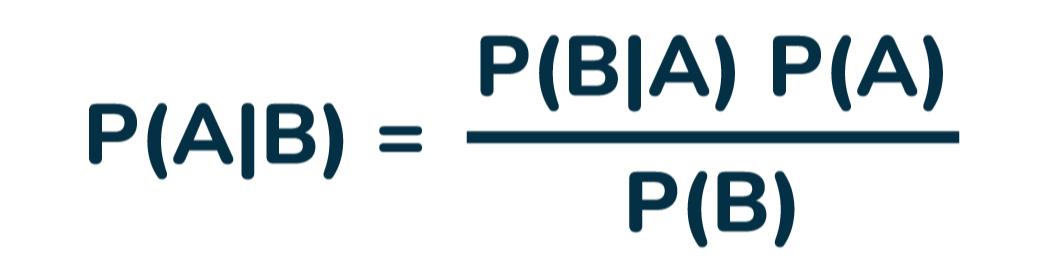
We previously looked at Bayes’ Theorem just briefly while discussing conditional probability and now we’re going to use it in some “real world” examples (i.e. the hypotheticals above). Before we do, we’ll have some warm-up lessons on conditional probability that will get us where we need to be.
Let’s suppose that we have an awesome medical diagnostic Test (T) that tests for horrible deadly Disease (D). We’ll start with a simple 2 x 2 matrix to see what the possibilities are. (This isn’t meant to be pedantic, but to help see what’s going on in medical diagnostics for later).
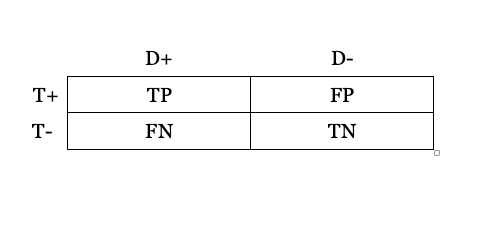
Across the top is your disease status: if you Test positive (the T+ row), you either have the disease (D+), which means you have a True Positive (TP) test result, or you do not have the disease (D-), which means you have a False Positive (FP) test. You could also have the disease (D+), but have a negative test (T-), a False Negative (FN), or you could test negative and that could be correct, so you have a True Negative result (TN).
Some important relations to understand about rows/columns: The total number of people who have the Disease (D+) is the sum of all of the True Positives (TP) with a correct test result – which is an ironic name – plus all of those happy souls who have no idea that they’re disease-stricken from a False Negative result (FN).
We use the term sensitivity to refer to the Test’s success rate: that is the True Positives (TP) divided by all of those with the Disease (D+ = TP + FN). Therefore, Sensitivity = TP/TP + FN.
Likewise, all of the healthy people who are disease negative (D-) are the sum of the poor bastards who have been incorrectly told that they are disease-stricken by false positive tests (FP), plus all of the fortunate souls who have had their lack of diseased-ness confirmed by a correct test result – True Negatives (TN). The True Negatives (TN) divided by all Negatives (TN + FN) is also called the Negative Predictive Value.4
The Positive Predictive Value (PPV) of a test is simply the total number of true positives (TP) divided by all positives, which is to say the total of both the true and the false positives. PPV = TP/ TP + FP.
Further Considerations: In order to know if our Test (T) is correct, we would have to have some independent way of objectively verifying the Disease (D) separate from our test (a “gold-standard”). For example, we could pretend that within 72 hours of getting our hypothetical disease, every single person who gets it breaks out in bright purple spots, thus confirming or disconfirming the disease. For our purposes, that’s been done with diagnostic tests already. One final, significant, essential item to know is the disease’s prevalence in the population that you’re testing. Why is that, you might ask? Well… in short, because it matters A LOT to the final outcome as we shall see.5
John Venn has Entered the Chat: …as it turns out, Venn diagrams are very helpful in illustrating conditional probabilities, especially when it comes to medical testing of populations. So, let’s have a quick refresher on Mr. Venn and then back our way into Bayes Theorem.
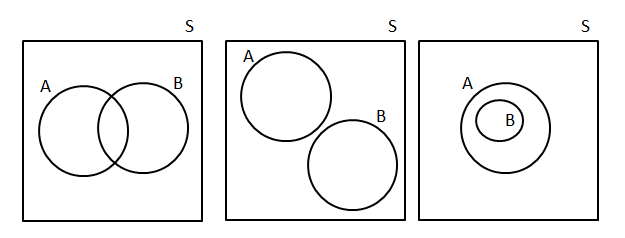
Consider two events, A and B, in some sample space S per the image below. The sample space S is a rectangle and two events, A and B, are drawn within as circles. This is just a visual way of seeing how some amorphous “events” can interact. The possible ways in which the events can overlap are: (left) there is some intersection between A and B, (middle) there is no intersection, and (right) there is complete overlap of A and B. In words, in the first image, some cases of B cause some cases of A to occur – there is some intersection (“∩”) between them. (i.e. Mathematically speaking, there is a set of something that corresponds to A ∩ B). In the middle image, there is no case of B causing A to occur at all (no intersection), and in the final one, every B results in A (plus A also has other cause outside of B!).
The probability of an event A occurring, given some other event B has already occurred, is written in symbolic logic/math as: P (A | B) and by definition that is equal to P (A ∩ B)/P(B).
Visually, it looks like the below picture:

The probability of A occurring given B is that small yellow-hased area divided by the whole of the probability of B. This is just Laplace’s definition and basic statistics made visual: the probability of an event occurring (dice rolls or coin flips or card draws) is the number of successful outcomes over the total number of possible outcomes.
PLEASE also keep in mind what this diagram suggests visually: A and B are two equally sized circles with some relatively small intersection (∩), hashed in yellow, inside of this larger white rectangle. In reality, in addition to what we noted above about the three possible intersection or non-intersection cases, we’re also not quite sure what A looks like in terms of its relative “size” (i.e. probability) as compared to B, nor as a portion of the rectangle. A and B might both be miniscule, tiny little circles, or B might be much smaller, etc.
For now, however, we use the simplest example visually to stand for a case where there is some P (A ∩ B) in yellow.
Similarly, the probability of B given A, written as P (B | A) = P (B ∩ A)/P(A), looks like this:
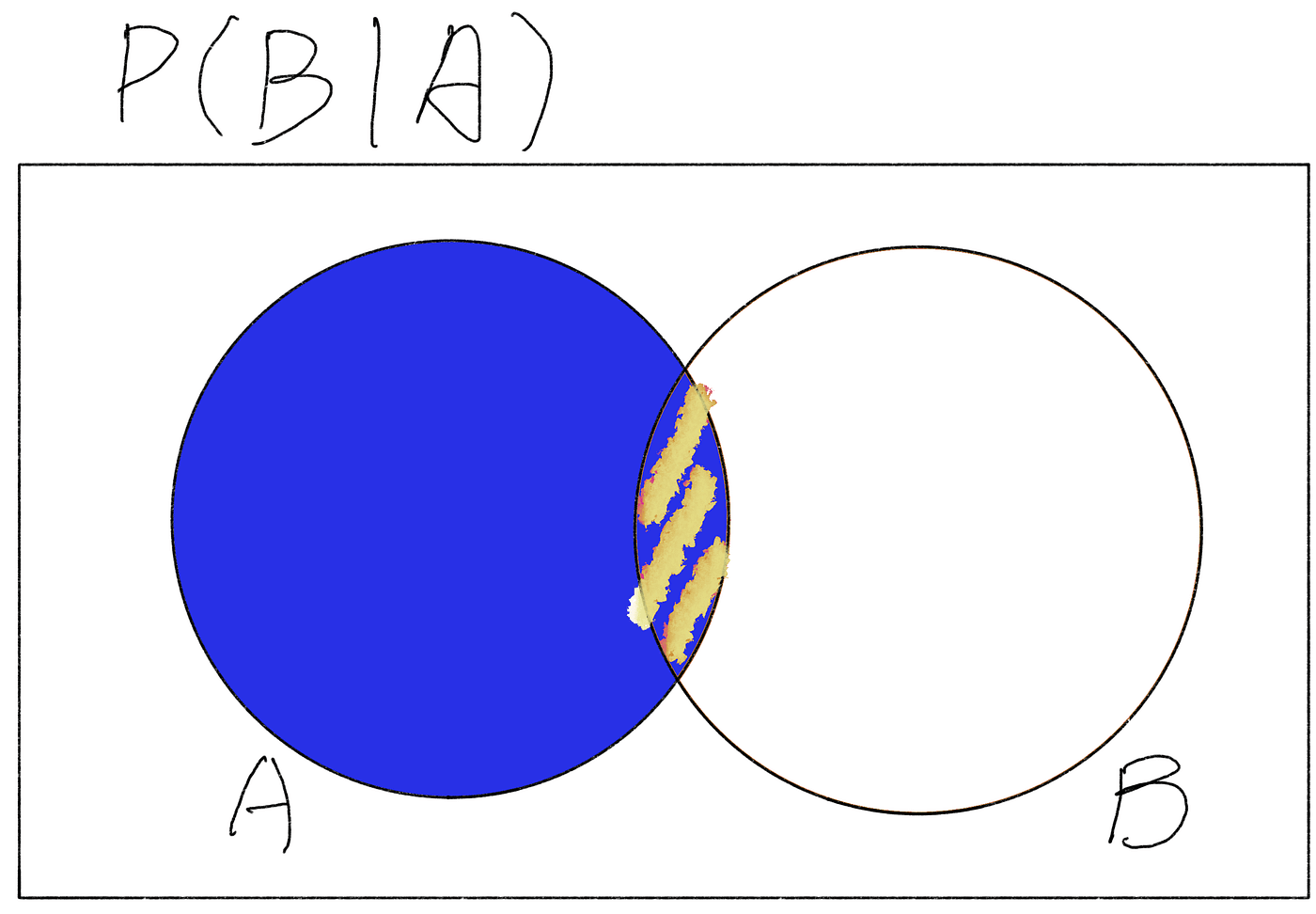
What’s important to say about this is that the P (B ∩ A) is identical to P (A ∩ B) from above. In other words, for the same probability space S, as long as we’re talking about the same A and B, then P (B ∩ A) = P (A ∩ B).
That little piece of information in common – being equal – allows us to manipulate our conditional probability equations to solve each for its respective “yellow-hashed” piece of the equation:
P (A | B) = P (A ∩ B )/P(B), when algebraically manipulated by multiplying both sides of the equation by P(B), can then rewritten as
P (A ∩ B) = P (A | B) * P(B)
This same manipulation can be done for B, such that
P (B ∩ A) = P (B | A) * P(A).
As noted above in the diagrams, P (A ∩ B) and P (B ∩ A) are the same, so we can set our equations equal, churn the math, and guess what it turns out to be?
Boom. You’ve derived Bayes Theorem. As noted previously:

Verbally: the probability of A given B is equal to the product of the probability of B given A and the probability of A, divided by the probability of B. Okay, wonderful, you’re thinking, now what?
C. Now Let’s See Who the Doctor Is.
Let us return to where we started, but instead of simply talking about how awful the medical profession was with conditional probabilities, it’s time for you to play Doctor, Doctor! Suppose that instead of using As and Bs in Bayes Theorem, we start talking about Ds and Ts, as in:
What is the probability that I have a Disease (D+) given that I get a positive Test (T+) result for “a disease whose prevalence is 1/1000 [the test] has a false positive rate of 5%?” (This is the original example in Casscells study).
What we can (perhaps) grasp now is that the prevalence of the disease in the population and the true positive and false positive rates of the test tell us (in Venn diagram terms) the relative shapes and sizes of A and B and their intersection within S. What these parameters tell us in mathematical terms is most of what’s missing from Bayes’ Theorem, and allow us to derive the correct answer to the question we really want to know: what is the probability someone actually has the disease if they test positive for it?
We can rewrite and redefine our As and Bs for our example and use our formula:
P (D+ | T+) = [P (T+ | D+) * P(D+)] / P(T+)
The Probability of a Positive Test given you have the Disease, P (T+ | D+), we will assume the test is pristine in this regard and it correctly captures everyone who has it. Thus, P (T+ | D+ ) = 1.6 The probability of having the disease, P (D+) is 1 in 1000 (prevalence). The only unknown remaining in this equation is P (T+), the probability of a positive Test (T+), which can be derived from what we already know. We know (from our grid above) that T+ is the sum of all the True Positives (TP) and False Positives (FP). (T+ = TP + FP). We can determine these probabilities by using the disease prevalence, the test sensitivity, and the test’s False Positive Rate (FPR).
The probability that someone gets a correct T+, P (TP) is simply the disease prevalence 1/1000 (or .001) times 95% TPR (.95, the test sensitivity). We then add the False Positives, which is the number of the 999 who don’t have it but still get a False Positive ( an incorrect T+), which is 999 multiplied by the FP rate of 5%. (999 * .05) = 49.95 false positives.
Now, let’s just think about this for a second.
You’re being tested for a disease that is relatively rare – only 1 person in 1000 gets it. The test itself is pretty good, wth a 5% false positive. That means that in every thousand people, only 1 person will have the disease and we assume that if he takes the test that it will correctly return a positive (T+). Of the remaining 999 healthy people (D-), however, roughly 50/1000 will get a test result that says they’re T+ when they’re NOT. (Quelle horreur!) You’re sitting there with a T+… are you the 1 correct positive or one of the 50 incorrect?
Well, the probability, or likelihood, or “odds” or “chance” if you want to use those latter terms, that you have the disease is roughly 1 in 51, or just shy of 2% (1.96%). In every thousand people tested, 1 is correct and 50 are wrong. You are far more likely to be one of the 50 than the single person in 1000 who has the disease – almost exactly 50 times more likely in fact.
Now, to close this out, realize that in the examples given at the very beginning, Harvard doctors would incorrectly tell a patient that there was a 95% chance they had this rare (possibly deadly?) disease. And consider that that there are 50 more false positives because of the low prevalence of the disease who have a 3 in 4 chance of being told the same incorrect probability. That’s a carnage of unnecessary and possibly life-changing anxiety for 50 people who don’t even have the condition…
Now multiply that across all of the tests shown on that Harvard website.
That’s your modern medicine as it stands right now.
- It is also worth noting that it is much easier for authority to manipulate an innumerate population than a numerate one. ↩︎
- “Interpretation by physicians of clinical laboratory results,” N Engl J Med. 1978; 299(18):999–1001. [PubMed: 692627] ↩︎
- Lawyers and doctors will know the joke. IYKYK. ↩︎
- Specificity is the related term of art on this side as Sensitivity is on the + side of the ledger. Specificity of a diagnostic is calculated as the number of true negatives (TN) divided by the total number of true negatives and false positives (TN + FP). ↩︎
- There is a term for this mistake: not taking into account a disease’s prevalence when calculating the probability that a positive test result means you have the disease is known as the base rate fallacy. ↩︎
- In other words, for “ease” of demonstration math, we’re going to ignore the specificity and NPV and just presume the test does not produce any false negatives (FNs). If you have the disease, you will “pop positive” every time. ↩︎

Ron – if you think your Stoic posts are comment killers, wait till you see this!
This is absolutely ego shredding for doctors.
Deserved. I have yet to meet a doctor with humility and my best friend became a doctor.
lol
I may have a relevant comment. Not sure. Until then…
What in the actual fuck. Been watching The Fourth Doctor on Pluto today and they just skipped eleven stories – more than an entire season.
Tomorrow I return to work from disability after two paid (((holidays))) and I thought I’d at least flip on my laptop even though I know I cannot log in because I could not the last time I tried a few months ago.
It won’t start, lol. I guess I won’t get much done tomorrow.
Just call tech support. It’s what we all love to do.
OT https://archive.fo/hhUpw
Enjoy the west coast tech bros shitting on each other in a panic over AI and layoffs.
HR told me I have to go through “Benefits” to get them to call IT to re-enable my account. I… don’t get it. But whatevz. It will probably take a couple days just to mail me another laptop so I guess I can kick back and continue to Glib all day for the next couple days.
PS. I never heard of that site. Thank goodness. CWABOA.
I make a good if not stratospheric salary that gives a me a living beyond my wildest dreams compared to what I grew up with so yeah, I rarely bitch about it.
Except that it hasn’t kept up with inflation. 😠
You did make me google Bayes’ Theorem to do the calculation.
I had to use it in college, grad school, and for professional education. However, I’ve never ever actually used it for a real life problem.
You’re welcome.
It was way easier for me to comprehend than continuous probabilities.
I am proficient in statistics, but far from gifted. I have, however, worked with people truly gifted and learned a great deal.
Most of that involves knowing what to ask and what the approximate answer is. Here one of the studies was multiple choice and the answer had to be under 5%. That only left you with one answer, no real math needed.
Maybe somebody should post a comment talking about what a horrible writer you are and what a crappy commenter one of the other commenters here is. That ought to get the comment count up.
/sarcasm after last night’s post
*Makes note to check the overnight thread*
Excellent idea. Ozy, make a quick extra log in, pretend to be a Tulpa and trash yourself. Profit!
I just wrote a story,
/kicks pebble
So now I have to wait, Yusef, but I have the time
Maybe, but these are really interesting and mine are just babbling.
Seriously great and mildly terrifying thanks for all these.
Day-um.
It’s an indictment of the whole system. Most of it is a giant con of one form or another.
A small percentage work miracles within a completely broken structure.
So the funny thing is, the conceit of the expert is so wildly unjustified.
Wait, more math?
All I know is that Web MD said I have Lupus, I’m going to increase my Acai berry *dosage so I’ll probably be okay.
*or maybe beets, Ill try both, can’t hurt.
Beets FTW. Don’t throw those tops away, you can do anything with them that you can do with chard.
I posted a message, and it disappeared.
Must be a sign.
Signs -The Five Man Electircal Band
https://www.youtube.com/watch?v=c9lh7lqZojc
So I have something that I think is in the 1 in 1,000 range but… do I really have it??
Check the diagnostic. You should be able to find out the relevant PPV, NPV, error rates, etc. and plug and chug.
My math stopped in HS. I was the star of the fucking math club and now I’m like a sub-moron.
If I *don’t* have it, the last year or so has been… well, interesting.
Move over, rhy. Same club. I picked up an adult refresher math book a couple of weeks ago because I felt like I’ve forgotten everything.
I have a couple “math for programmers” books on the back burner.
I really do love math, but… yeah.
I wasn’t the star, but I did letter as a high school mathlete. I graduated number 3 in my class of 200-some students and quickly realized I didn’t know shit when I went to college.
Hey sweet, I like math. Needs an ass slapping GIF to draw people in though.
Then post a .gif of you slapping your ass.
Draw them in, not drive them away.
People would come to point and laugh at you. :-p
Good point! Let me send Swissy a picture of my ass getting slapped and see what comes of it. (waggles eyebrows)
Thanks, Ted, now I feel icky.
You’re welcome. It’s what I’m here for.
Better than being left sticky?
This was an awesome article.
Also I am traveling through Kyushu and have no idea what time it is there, but kudos to Elon.
I’m jealous!
If it’s Kyushu Tonkatsu Ramen needs to be on your agenda!
I was in Tokyo, Osaka, and Kyoto before and we will be back there in 3-4 days.
My wife’s family is from town on the southern tip of Kyushu and we are here for an 88th birthday. Some of my kids don’t really remember Japan as they were too young last time.
My favorite thing last time was we stayed in a hotel/bath in Sakura-jima. I’ve been told, though, they closed the hotel and am sad about it.
I love Kyushu though. It’s a beautiful place that looks almost like mountainous jungle in some places.
There was (is?) a ramen joint in my office building in Jersey City serving that. $15 and worth every penny.
That was a sometimes lunch back when I worked in the office.
One of my son’s HS friend’s mother was from Kyushu.
The dialect there is considered “cute” when used by young women. Not sure what that gets you as guy that grew up there however…
It’s the dialect my wife speaks and she says people think she’s a country bumpkin when she comes to Tokyo though.
She’s a managing director for Goldman Sachs. Really she grew up in Orange County and only spent summers in Kyushu. But her parents don’t speak great English and her country Japanese is passable.
Yeah, she’s got the problem that she learned Japanese at home.
For heavy dialect areas people pick up standard Japanese usually at work if they are professionals and at high school and beyond.
I can see the issue in Tokyo as somebody fluent and no longer in their twenties. If she was educated she’d speak standard. However, she grew up in the U.S. her standard probably has an accent.
Fukuoka reminded me most of being in a large American city, compared to the others I’ve been to. Did not make it to the Toto factory museum last time.
I have never been to the north tip of Kyushu. They are closer to Kagoshima which feels almost townish compared to Osaka or Tokyo.
Honestly the urban sprawl of those two places gets suffocating to me after awhile. It’s impressive but at the same time draining.
And while I’m intellectually impressed by the public transportation my ugly American opinion? American car culture kinda rules actually.
Anyway hopefully I get some tonkatsu ramen today.
I just think of it as a collection of neighborhoods connected by Mario style warp pipes. Pop out of the subway and hey, here’s the destination!
She’s a managing director for Goldman Sachs
TIL Urthona is a trophy husband.
Venn diagrams make a fun game too.
https://www.veryspecialgames.com/products/venns-with-benefits-the-hilarious-venn-diagram-game
I wanted to post a joking review of Doom (2016) where I jokingly trashed it.
But it caused a legitimate issue. In any video game if I’m running around the same space for too long, I get headaches. Doom has small arenas where the exit doesn’t open until all the enemies are killed. This leads to having to run around the space hunting the last Zombie. I had to nope out with headaches.
This makes it an apt sequel to the original Doom where the billboarded sprite art also caused me headaches.
Waiting for liberal heads to explode.
Not following this closely I thought this asshole was already a lock.
Santa Ono Blocked From Becoming University of Florida’s President
https://archive.fo/WQylR
lol
But let’s be honest. It’s not really “leniency toward pro-Palestinian protesters”.
It’s leniency toward fucking communists.
He also has a paper trail of support for DEI and whites essentially being racist, but not other races.
Oh, I’m sure.
I just think it bears repeating that the pro-Hamas crowd is really just the same crowd of commies that have been shitting all over everything for decades.
Is Yoko still available?
the correct answer is a positive predictive value (PPV) of 1.96%
I came up with two in my head. Good enough for most purposes.
This is a defense of not giving Joe a prostate exam for a decade, isn’t it?
LOL
Anyone up for a nut punch?
https://youtu.be/Y-ZbME4qfOI
Let’s see: false arrest, kidnapping, assault, various federal civil rights violations, conspiracy. Just off the top of my head. Same with the other officers who agree with “teaching him a lesson”. Everyone of them should fired on the spot and be breaking big rocks into little rocks while wearing striped uniforms.
Totality of the circs, yo. He deserved it for sitting on that bench.
Watched a few vids now…good channel.
I was trying to make the point this weekend if you’ve read one book on a medical topic, you know more about it than your doctor does.
My uncle, who thinks he’s a doctor, then tried to get me to take Ozempic.
Dr Mike Eades (of “Protein Power” fame) and his wife (also, a real “Dr”, not a Jill “Dr”) are friends and I subscribe to his newsletter. Frequently he discusses – in detail – “studies” or latest “new things” in obesity, diabetes, or whatever. He’s an old school country doc from Arkansas and I love him. Anyway, he reviewed all of the Ozempic literature and studies as it was first coming out, a good while back, and he called it, right down to the mechanisms of harm. He’s a super-bright and inquisitive guy and he was all over Ozempic calling bullshit a LOOONNNG time ago in several different editions of his “The Arrow” newsletter.
Is Ozempic the stuff that makes you dance around? I should ask my doctor about that.
LOL the commercials do make it look like a lot of fun.
LOL.
No, that’s the one with a big story to tell. 🤣
This was a fantastic read, and much appreciation to the work you put in it.
I had to take 300-level statistics at IU-Bloomington, and I got a C-. (Possibly a Gentleman’s or Pity C-.) The tests were open-book. Ironically, it was the only math I actually ‘enjoyed.’ I saw the practical purpose of it and it made sense. The issue is, my brain doesn’t like to work in mathematical ways, though I’ve passively reinforced not thinking that way, so it’s not all to blame. (Damn frontal cortex, thinkin’ of its own preferences rather than what’s BEST for Ev!)
I never had to take an English class at IU. Signature School in Evansville was Indiana’s first charter school, and I was in their first graduating class. I took enough AP classes, five my senior year alone, that I was 3hrs short of being a sophomore coming into college. Rather than graduate early, I took part-time gigs and only 12hrs/ semester over four years.
That was an extremely good decision, IMO. Thanks for this great piece. I’d like to hear from RC Dean and numerous others here who deal with the misunderstanding behind statistics in their field. ‘Twould be mighty interesting to hear.
Some of us high-school eggheads were offered classes at the local community college one semester – the choice was a statistics class or astronomy.
I chose astronomy. Alone. The other three or four did not.
Let me offer two (weak) and only partial defenses of doctors.
1 – Ever since the medical professional went the pharmacological solution route – i.e. the “magic pill or injectable” theory of human health, AKA better living through chemistry™, it was inevitable that the profession, and its teaching, would become beholden to those interests.
2 – More importantly, the most important math for doctors to know would be dosing math, and possible fatal drug interactions. Getting diagnostics math wrong is only “possibly” fatal if you miss something on a cancer screening, and even then with all of the other diagnostics available, what’s the likelihood you get sued?
It’s also much harder to quantify ($$) the harm of a false positive: “whoops, we thought you were dying, but, hey! don’t be so glum!! You’re gonna live!!” The false negatives, however, are the ones that cost real money.
There’s also a natural trade-off between a test’s specificity and sensitivity – that’s just the way it is.
I was on an impressive list of drugs in April down in NYC after a procedure. Then I caught a half dozen bugs from the randos assigned to watch me and I didn’t have to keep track of the drugs anymore cuz I was in the hospital for a week and a half. Whee!
Now the list is much easier to follow.
2A) wash their dirty ass dick beaters and clit flickers
Wait, what did I miss?
https://pmc.ncbi.nlm.nih.gov/articles/PMC1115132/
Okay, SO. This came up in my interview today. I had to explain that part of an MT’s job is to double-check dosages the doctors dictate. They don’t get it wrong OFTEN, but if it’s a drug that’s not part of their specialty, they might and occasionally do. We check the chart and fix it. No big.
HOWEVER, this one doc made a really really really bad error. It was so bad I wasn’t comfortable just fixing it (as we do), so I sent it back to the doc and said, “This is not the right dosage. Please clarify.” He was very grateful.
We’ve often been told to act as if we are going to be liable for these reports in a lawsuit. No. No, I will not. I will do the best I can with what I’ve got, but there is no way on God’s green Earth my $20-an-hour ass is going to take responsibility for a physician’s stupid mistake, especially in his own specialty. If I were a nurse, I’d think differently, but I’m just a clerk.
I’m still trying to divide all these numbers by zero, and I keep getting different answers.
Does that make me an expert?
The Toppest of Toppe Men.
Just in time for pride month, too.
Dude.
I got a D in logic. It was a pity-D, too, because I was about to graduate.
Thanks, Ozzy! I was actually able to follow that, and me not math so good (high SAT was all Verbal).
Had an extra day off today as I have few PTO days I have to burn before July 1st to get the rest of my PTO overage paid out. The only time I left the house was to go out to my porch fridge. It was a rainy day, good one to stay in.
Finally had the time to replace my laptop HDD with an SSD, works great. Won’t have any trouble getting on the glibzooms now.
@Ted’S, this popped up in my YouTube feed. Thought you’d like it, but also thought you’d probably know all this already.
Fred MacMurray if known from his Disney movies. Not so unexpected as the two faced asshole in The Caine Mutiny. Speaking of which, had strawberries with ice cream tonight. Summer begins.
I think it wasn’t until after The Apartment that MacMurray really decided to go for the Disney/My Three Sons image.
Yea, but this has nothing on Yusef’s short stories.
🫣
Happy national cheese day, all you crackers!
🐪🤣🧀
https://www.youtube.com/watch?v=fM1S9S-Q2sU
🎶🎶
Good morning, Sean, Bro, and Ted’S.!
I will definitely make a point of observing National Cheese Day with all the reverence in deserves! 😋🧀
Mornin GT and the rest of youses.
Good morning, JI! How are you today?
Terrifying: https://www.cbsnews.com/newyork/news/ai-voice-clone-scam/
https://6abc.com/post/police-chase-ends-deadly-montgomery-county-crash-ridge-pike/16650144/
I guess they won’t be robbing anymore Targets. 🤷🏼
There once was some robbers in Limerick
that couldn’t drive worth a lick
Though they tried
and they died
now they’re up shit crick
Kindly old Fourscore
Makes honey, but with gore.
He steals from the bees
And then lets them freeze.
Oh noes! We have a code orange air alert today. 🙄
All these weak-ass bitches…
I’m sorry you’re a weak ass-bitch.
You should squat more.
80 years on….
https://www.dw.com/en/germany-20000-evacuated-in-cologne-as-wwii-bombs-defused/a-72782573
Almost like a gift that keeps on giving.
Once again Ozzy, I apologize. I went to bed before the sun was below the trees. The sun is now not quite above the trees and I am just starting to read.
One paragraph in and here is my ‘thing to keep in mind’. People often start with what they want to end up with. Sometimes it is outright mendacity, they do it deliberately. See: The Faucian approach. Most of the time is is unknown to the person doing it. See: Being human.
I mention this because I must be on guard. As soon as I see ‘Covid-19’ my rational brain turns off and I am tempted to spit on my hands, hoist the black flag, and begin slitting throats.
I get the temptation to slit throats. Thing is, the masses demand that someone be in charge, partly so we have a scapegoat when things go bad.
So far though, there have been no apologies.
Scammers can learn a lot from the government.
I dont remember who used the analogy first but I do remember you using the term ‘late stage aristocracy’ to describe today’s ruling class. I think that is very accurate because the trait most notable to me is the absence of any accountability for the corruption and incompetence of those in charge.
In such an environment the scapegoat is us. Obama was very clear about that.
I hope UCS is OK. He’s not here to complain.
Maybe he’s stuck in traffic. We’ll find out soon enough
Move over Nancy Mace and Anna Paulina Luna. There’s a new RW thot leader coming to DC
https://x.com/ScottMGreer/status/1930116473726312884
Beth Grotelueschen
https://x.com/milk_speech/status/1929371779845304352
thicc?
Vera Dijkmans
https://x.com/milk_speech/status/1930097997154529652
thicc?
suh’ fam
whats goody
Beth and Vera may keep me a bit in bed after I woke up, tho clear of work and officially off today, an official dream.
Now to make the day productive, and I may know how. Must rediscover my “engaging voice,” I say.
Rupprupp, morning muzzle rub ‘n yawn on your ankles.
My wife makes soap. Wow, you should see the instructions and hear the soap-makers talk about their craft.
It is pure alchemy. In the beginning I had to constantly check myself from shaking my head and starting out with “Well, ackshually….”
It’s no harm, no foul, do what you like.
Then I saw the product she made. Holy crap. Pure art. I will never guy mass produced crap they call soap again. I shut up and let her do her thing.
I saw this in lab quite a bit, both in school and out. A room full of people follow the exact same instructions using exactly the same ingredients and out of 20 maybe 5 get It right. Even in the most austere application of science and math there is an element of art. Some people have it, some people dont.
The same is true of the practicing physician. They look at the same symptoms and same test results and maybe one in five get it right. When I ask how they say “Yes this and that and the results say X but I noticed this little thing (most think is unrelated) and I have seen that before. That usually turns out to be Y.”
A little bit of art, a lot of experience and intuition are indispensable. This holds for both diagnosis and treatment.
Same with art and music. Some people hear and see things that never cross my mind. We each have our skills, our motivations, our interests. Most of the time it for producing positive results, occasionally not so positive.
There are some that don’t care about productive pursuits and prefer living off the work of others.
Still in the hospital, they were going to do a colonoscopy today and I did half of the prep last night.
Started bleeding heavily again this morning and am a little light headed.
Not sure what is going on, Dr. seemed pretty hapoy with my progress yesterday.
Get well soon!
Take care, Ron! Please keep us posted as you’re able! 😟
Feel better!
We need you, Ron. See you in September.
Best wishes for an accurate diagnosis with simple effective treatment!
But best wishes regardless. As 4(20) said, we need and value you.