
Our last story told the tale of some Marines (one in particular) and their actions on some godforsaken disease-riddled island in the Solomon chain called Guadalcanal.
But while the Marines had won their battle on land, it would be meaningless unless the U.S. Navy could figure out a way to stop losing night battles in “The Slot” to the northwest of the island, through which the Japanese kept sending in warships and transports filled with supplies and reinforcements for their own desperate forces on Guadalcanal.
The U.S. Navy had lost so many ships in those dreaded night actions that the waters off Savo were given the grisly sailor’s nickname by which they’re still known today: Ironbottom Sound.
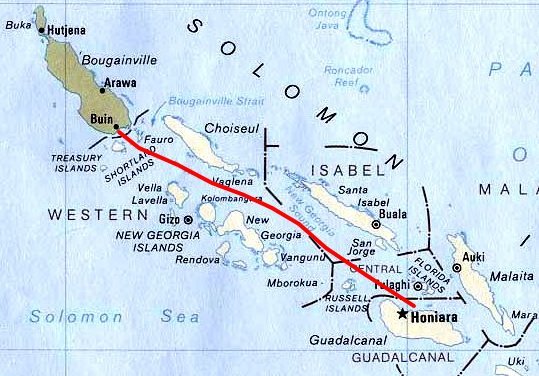
“The Slot” — Ironbottom Sound is just north of the northwestern tip of Guadalcanal
So grave had the situation become that finally, 18 days after Mitchell Paige won his Congressional Medal of Honor on that ridge above Henderson Field, Admiral “Bull” Halsey himself broke a stern War College edict — the one against committing capital ships in restricted waters. Gambling the future of the cut-off troops on Guadalcanal on one final roll of the dice, Halsey dispatched into the Slot his two remaining fast battleships, the USS South Dakota and the USS Washington, escorted by the only four destroyers with enough fuel in their bunkers to get them there and back. The only remaining U.S. carrier in the Pacific, Enterprise, was damaged in the previous month’s Battle of Santa Cruz and was kept far away from the action.
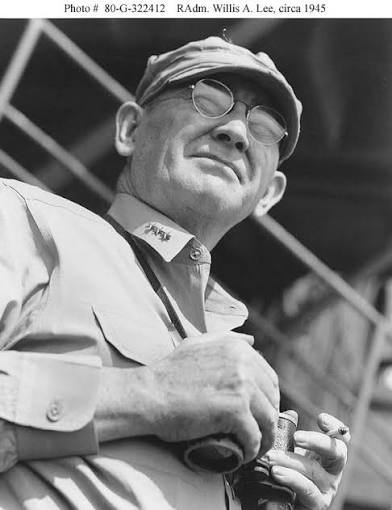
In command of the 28-knot battlewagons was the right man at the right place, gunnery expert Rear Adm. Willis A. “Ching Chong China” Lee. Lee’s flag flew aboard the Washington, in turn commanded by Captain Glenn Davis.
Lee was a nut for gunnery drills. “He tested every gunnery-book rule with exercises,” naval historian Walter Lippman writes, “and ordered gunnery drills under odd conditions — turret firing with relief crews, anything that might simulate the freakishness of battle.”
Lee’s obsession with gunnery was a result of a near-lifetime of practice. He was born Willis Augustus Lee in 1888, and was known as “Moss” to his family and friends. When he arrived at the U.S. Naval Academy in 1904, his fondness for the Far East earned him the nickname “Ching” Lee to his fellow midshipmen, later lengthened to “Ching Chong China.” So proficient was he with firearms that, at the age of nineteen, he became the only American to win both the U.S. National High Power Rifle and Pistol championships in the same year. Lee went to the 1920 Olympic Games in Antwerp and won seven medals in riflery, five of them gold – a record haul for one Olympics that stood for decades.
As it turned out, the American destroyers need not have worried about carrying enough fuel to get home. By 11 p.m. on Nov. 13, outnumbered better than three-to-one by a massive Japanese task force driving down from the northwest, every one of the four American destroyers had been shot up, sunk, or set aflame, while the South Dakota — known throughout the fleet as a jinx ship — managed to damage some lesser Japanese vessels but continued to be plagued with electrical and fire control problems.
“Washington was now the only intact ship left in the force,” Lippman writes. “In fact, at that moment Washington was the entire U.S. Pacific Fleet. She was the only barrier between (Admiral) Kondo’s ships and Guadalcanal. If this one ship did not stop 14 Japanese ships right then and there, America might lose the war. …
“On Washington‘s bridge, Lieutenant Ray Hunter still had the conn. He had just heard that South Dakota had gone off the air and had seen (destroyers) Walker and Preston “blow sky high.” Dead ahead lay their burning wreckage, while hundreds of men were swimming in the water and Japanese ships were racing in.
“Hunter had to do something. The course he took now could decide the war. ‘Come left,’ he said, and Washington straightened out on a course parallel to the one on which she (had been) steaming. Washington’s rudder change put the burning destroyers between her and the enemy, preventing her from being silhouetted by their fires.
“The move made the Japanese momentarily cease fire. Lacking radar, they could not spot Washington behind the fires.
“Meanwhile, Washington raced through burning seas. Everyone could see dozens of men in the water clinging to floating wreckage. Flag Lieutenant Raymond Thompson said, ‘Seeing that burning, sinking ship as it passed so close aboard, and realizing that there was nothing I, or anyone, could do about it, was a devastating experience.’
“Commander Ayrault, Washington‘s executive officer, clambered down ladders, ran to Bart Stoodley’s damage-control post, and ordered Stoodley to cut loose life rafts. That saved a lot of lives. But the men in the water had some fight left in them. One was heard to scream, ‘Get after them, Washington!'”
Sacrificing their ships by maneuvering into the path of torpedoes intended for Washington, the captains of the American destroyers had given China Lee one final chance. The Washington was fast, undamaged, and bristling with 16-inch guns. And, thanks to Lt. Hunter’s course change, she was also now invisible to the enemy.
Blinded by the smoke and flames, the Japanese battleship Kirishima turned on her searchlights, illuminating the helpless South Dakota, and opened fire. Finally, standing out in the darkness, Lee and Davis could positively identify an enemy target.
Washington‘s main batteries opened fire at 12 midnight precisely. Her new SG radar fire control system worked perfectly. Between midnight and 12:07 a.m., Nov. 14, the “last ship in the U.S. Pacific Fleet” stunned the battleship Kirishima with seventy-five 16-inch shells. For those aboard the Kirishima, it rained steel.
In seven minutes, the Japanese battleship was reduced to a funeral pyre. She went down at 3:25 a.m., the first enemy sunk by an American battleship since the Spanish-American War. Stunned, the remaining Japanese ships withdrew. Within days, Admiral Yamamoto and his staff reviewed their mounting losses and recommended the unthinkable to the Emperor — withdrawal from Guadalcanal.
Lee was awarded the Navy Cross for his actions at the battle, promoted to vice admiral in 1944, and placed in charge of the Pacific Fleet’s fast battleships, as Commander, Battleships, Pacific Fleet (ComBatPac).
In May 1945, he was sent to the Atlantic to command a special unit researching defenses against the threat of Japanese kamikaze aircraft (more on that later), the Composite Task Force, U.S. Atlantic Fleet. While serving in that position on August 25, 1945, Vice Admiral Lee passed away suddenly after suffering a heart attack, ten days after the surrender of Japan, though two weeks before the surrender documents were signed on the deck of his former command Missouri. He collapsed and died in a motor launch that was ferrying him out to his flagship, the gunnery training ship (of course) USS Wyoming, in the harbor of Portland, Maine.
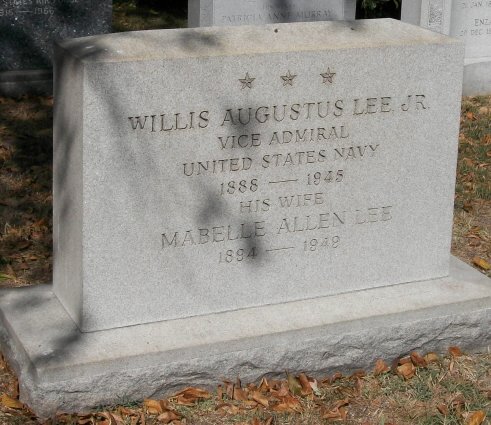
Lee is buried in Arlington National Cemetery.
The U.S. Navy’s path to victory in the Pacific was forged in no small part to the best damn man with a rifle you’ve ever heard of – no matter the rifle’s size. A man who, when chaos descended around him, trusted in his plan, his abilities, and his sheer nerve.

Tough guys back in those days. 57 years old and still wanting to fight…
War? What war?
U.S. President Donald Trump said on Monday that the war with Iran could end “fairly soon,” adding that Tehran was “talking very politely” with Washington.
Trump told reporters in the White House Monday, after a meeting with Qatari Prime Minister Sheikh Mohammed bin Abdulrahman Al Thani, that “We’re seeing momentum toward the end of this conflict. I think it’s going to be ending fairly soon.”
“Iran militarily is effectively over,” Trump said, citing the destruction of its navy and surging inflation that he said has hollowed out its economy.
Does a pyrotechnic display and a bunch of name-calling really count as a war?
I’d worry more about Trump (rightfully) blaming the war as the end of his second term and now cutting his losses and running.
Fucker started this and regardless of what anyone thinks of that it needs to be ended satisfactorily. I don’t even know what that really looks like here. You can talk about how broken Iran is internally but people can and have obviously endured a shit ton of hardship during aerial bombardments in history if they are given cause to.
At the end of the day the Trump regime has very little political leverage and I suspect very little will to keep this going no matter what.
I fully suspect this to end badly for the US regardless. If Trump doesn’t fold, the Dems in Congress will tie his hands because they sure as fuck don’t give a damn about long term thinking.
I make a lot of jokes about the proud naval tradition of sodomy, but I have to admit that the idea of dying at sea always seemed particularly grim to me. Part of the issue is that I could never swim to begin with and never much liked large bodies of water as well. But yea that always seemed like one of the worst ways to go.
I thought about the navy but not for very long. I could walk/run better’n I could swim.