

For rock stars, athletes and ordinary folk alike, life in their 20s is likely the most powerful and guiding decade of their lives. Times, places like hippies in the 1960s, Capone’s Chicago, and so forth, became scenes to be experienced. My wildest decade was spent teaching English in Asia, but the scene was migratory. In 2014, four years into my decade-plus stint in the Orient, I was part of an ex-pat exodus from Daejeon, South Korea to Singapore with three other couples. Most of us signed two-year contracts with different branches of “I Can Read,” a phonics school mostly for 4 to 8-year-olds. Prianka, my then-girlfriend, signed with a similar school off Orchard Road.
An island 30 miles from east to west and 17, north to south, Singapore’s home to six million people. Take away the ports and the shockingly large reservoirs and greenspaces, maybe half the land is actually inhabited (by humans). Smack-dab on the equator, the dense city-state is a vortex of human insanity unlike any other I’ve ever experienced, a sci-fi world on Earth.
Imagine the airport in Men in Black, with all the different aliens going about their business, and everything is as normal as possible before their flights. All this despite the different arms where arms don’t belong, entities without faces and lifeforms breathing bubbles as they sashay about, with all the different languages and customs – and appendages – they all separately have, and everything’s as organized and polite as interstellar travel can get.
Well, that’s Singapore, but they’re all human and from different, mostly Asian countries and cultures, all swaying in-and-out of everyone else’s worlds and back into their own. It’s a large Manhattan in the jungle, with the whole world swirling together in one of the richest countries in the world, distinctly Asian, but stuck together with English glue.

Shopping mall on Orchard Road, the shopping and fashion district of Singapore. Not where Pri worked.
Reality frequently slaps you to remind you where you are, in a place where long-tailed macaques also call home. The crab-eating macaque. These guys are ten to twenty pounds and about knee-high, walking on all-fours. They’re used to humans. Certainly not friendly, but chill. (Well, other than that one time…)
Macaques are numerous in Singapore, in the “least-endangered” category. Sometimes when going around the city, your bus will pass by an empty stop, and there’ll be a macaque in one of the seats, possibly snacking, comfortably covered by the stop’s roof. (Sadly, I never saw one waiting next to a human.) They were just taking a break from the sun or the rain, just like you might if you forgot your umbrella.
That didn’t happen everyday, but I got used to it pretty quickly. You get used to the weather pretty quickly, as well, depending on how you measure time. To start, every day is about the same, with a high/low around 90/73 degrees F (23/32 C). Getting in the 60s? An escape, and above 95 is a swampy, humid sweat-storm, and far more frequent. Dry heat? Singapore is jungle hot. Parboiled hot. Every month and day of the year.
Thankfully, air-conditioning is Singapore’s mechanical mascot, and they do not skimp. Every place blasts it and walking down the dense, storefront streets, the auto-doors give you a potent punch of arctic chill as you pass, one after another. Gals, blessedly in airy sundresses, sometimes lead the way. (Trapped in soggy pants myself, like a jellyfish herder, their breezy fashion choices are still a Win for me.)
It rains every other day, or so. I’m not sure I recall just a sprinkle, only downpours. The storms crossing the ocean sometimes turn into monsoons. Forget the faucet. Dump the whole sink for a couple of days straight. Graciously, most showers are short and pass in a few hours. A sudden collapse of rain, like someone pulled the tablecloth from underneath the fish-tank clouds.

Sunset over the ocean was about an hour away on public transport. Shipping’s always afoot.
Back to time, Singapore has a way of making you forget about it. Onthe equator, you get 12 hours of daylight and 12 of nighttime every single day. You don’t get any seasons. (Other than monsoon season, they say, but I never really noticed, frankly.) The shocking part for me and our friends was how without winter drifting through and out of summer, we lost reference to help locate memories in time. Pictures alone didn’t help because the weather is always the same; leaves don’t change color and flowers are always blooming. And macaques don’t hibernate. They’re always around (running late for something, apparently).
A quick look at Singaporeans shows about 75% are Chinese, 15% Malay, 9% Indian, and the last 1% is, well, the rest. Having said that, apparently about 30% of residents are foreign workers and come and go, like our expedition.
Thanks to the British, however, everywhere you go in public is in English first, followed by translations below. The legal system is in English. All business is in English. Even older locals will be able to speak it enough, and they ‘all’ have incredibly strong accents. But casual conversation, ordering food, instructions for a taxi driver, talking at work, being sentenced to caning, all in English, no problem. (Well, that last one would be.)

All pics are a decade old, apologies, but the heart of downtown. Fullerton Hotel visible at bottom, center-right.
Locals talk to each other in English because groups are often mixed. As soon as they talk to friends or family, however, their native tongues run free.
Singaporean English, Singlish, is fantastic in its brusque simplicity. By far the most common expression is “Can!” It simply means “Yes, I can do that,” “Yes, I did that,” or “I will do that.” They add other syllables with meaning, but I don’t know the difference. I do remember “can can” because it’s stronger, like “I absolutely will.” And it’s fun to say, especially in context, because the stronger people push the sounds, the more serious it is.
Helpfully, “can not” is the exact opposite of “can,” and it’s always two syllables.
Listening to our schools’ front desks was hilarious. We ex-pats would hear staff respond to bosses on the phone, as the invisible higher-up would give a litany of names, tasks, or whatever they were talking or asking about, in English or whatever language they knew they shared.
On our end, we’d hear staff respond with great enthusiasm to each: “Can! Can! CAN NOT! CAN! CAN NOT! CAN CAN!”
At work, we were also exposed to perhaps the biggest culture-shock in my life. Let’s just say, some parents didn’t really believe in dental care. Their baby-teeththed kids would walk around with a black dagger of a dead tooth (or three) in their gumlines. Normal life sanded them into obsidian razors, jutting out through their pink mouths.
For maybe 10% of our students, this was normal. In the second-richest country on Earth. Children in class would be cheerful, bouncing up and down, participating, and the numerous, jagged black shards were nasty gut-punches to ignore as we taught kids their short vowels.
I asked Pearl, our pristinely-dentitioned local teacher at my school, who answered in disgust. She said some parents (usually Chinese, she wasn’t shy of adding), wouldn’t waste money on baby teeth that were going to fall out anyway, so the parents just let them rot off.

From a cable car as Pri and went to Sentosa, Singapore’s island of theme parks, incl. Universal Studios.
Nevermind Dickensian dentists, Singapore’s a bustlin’ place. It’s also incredibly expensive, particularly for food and drink. Pri and I, along with our ex-pat friends, and many Singaporeans found it easy to get around the costs. Just fly out of the country! (Changi Airport (SIN) earns its reputation as the best in the world.)
We went to either Phu Quoc, Vietnam, or Phuket, Thailand to ring in 2015. (Who can remember, eh?) They’re both only a 90 minute flight away. To splurge, Bali’s about two and a half hours, and once you get to these exotic spots, hotels, food and entertainment are damn cheap!
Trying to live out their fantasies and see these spots after they retire, old folk waste so much time getting old they miss these cheap, local flights. (And their youth.) Now, it’s maybe $1500+ from Chicago, but either destination was about $50 (round trip) from my home back then.
Pro tip: Fly into Bangkok or Saigon, and then take a bus to Phuket or wherever. Toughen up.
(See also: Don’t have children.)
I finished my contract in ‘16 and went back to Indiana to see my family. Then, after a few more spells in Daejeon, with an interlude in Chiang Mai, Thailand, I returned Stateside for good(?) in June of ‘22. Singapore was a remarkable knuckleball in the mix, predictable in its unpredictability. A dense, southeast Asian Monaco in the ocean. All in comfy English.
I haven’t yet returned to that equatorial cyclone of affluent madness, but if I could drop a (friendly?) alien anywhere on Earth to show them what this planet’s really like, and we only had a day or two? Singapore’s easily the best spot for ‘em to land, or whatever it is they do.

The greenspace trails are lovely. That squiggly tree shows a lot of character.
That alien better be a well-behaved one and not act like an urban camper in San Francisco. Singapore don’t play.
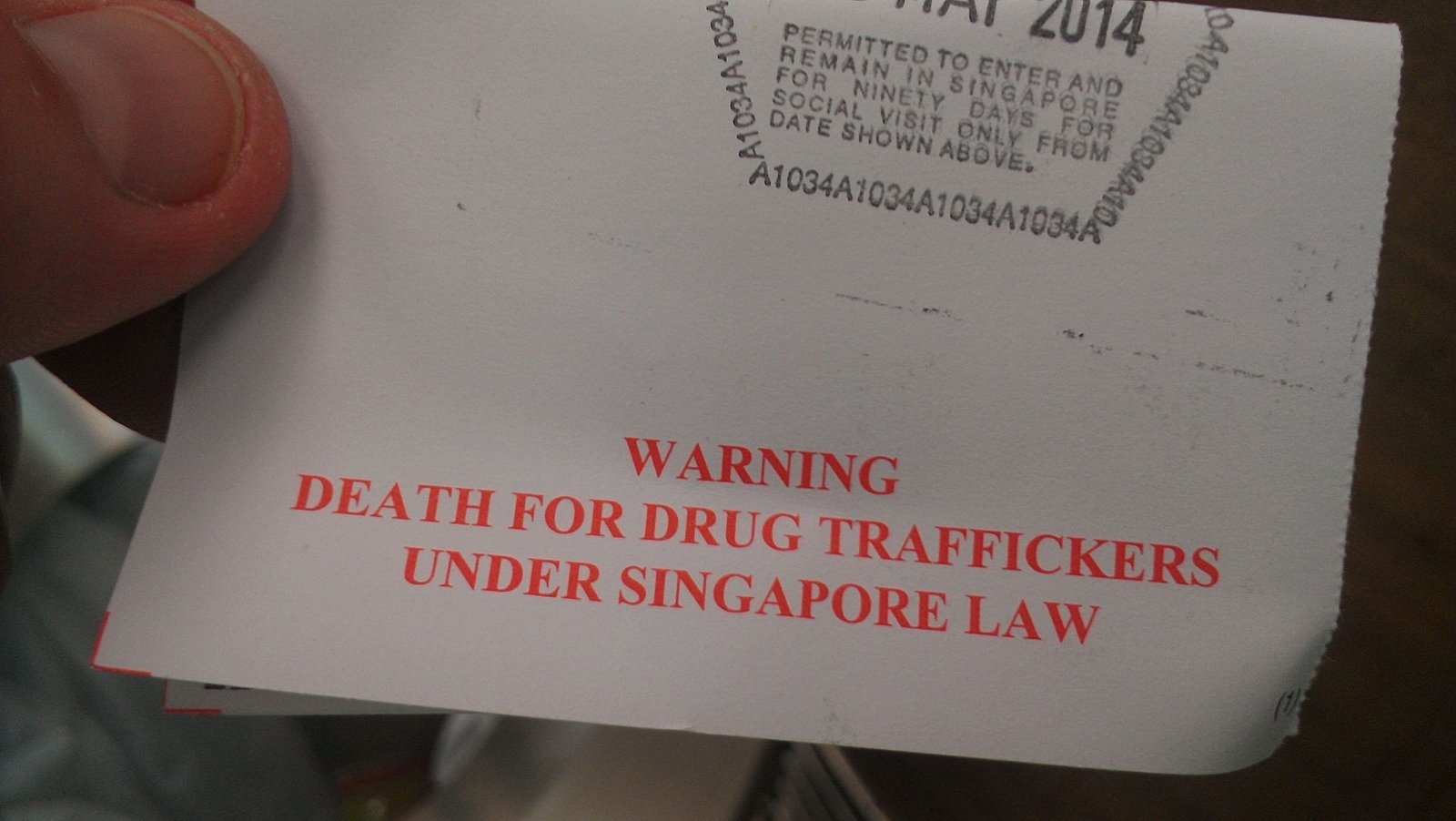
A 90 Day visa from our test-visit to scope it out. I wouldn’t dare risk overstaying it.
************************************
Sharing my hawker and food experiences is for later. There are other fun details about teaching and life in Singapore. There are some interesting political twists, as well. I believe I’ll reveal what happened that one time with those damn macaques.
While writing this, I was offered and accepted a job, causing much delay. For a hopeful Part 2, let me know what you’d like to see and hear, and I’ll do my best to oblige. Help me out, or Singaporean spirits will linger. Ya may end up like this dude:
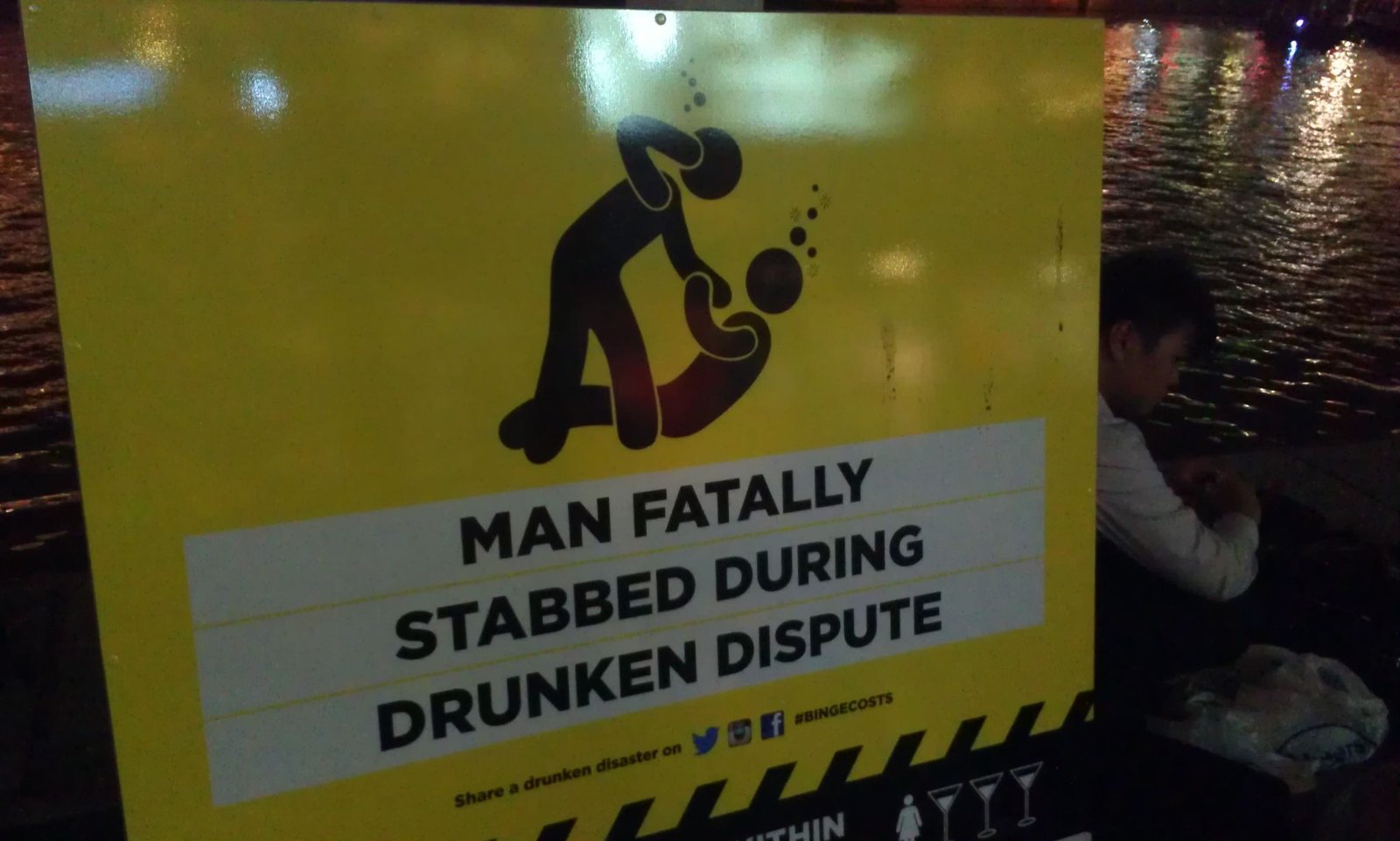
(Note the man on the curb with his hawker food: Singapore, in a nutshell Styrofoam plate.)

I can not can can.
Begs to differ
Can can can?
Us Indiana folks are into the Christmas Can Can.
https://youtu.be/7E-47VmFopE?si=ghhYwFpSWUFhJeAw
Can not even, Evan.
Thanks Evan,
Next best to being there. Waiting, waiting ’cause I know you can can-can.
This is from one of my YouTube subscriptions. Focused on both Asia and Tech.
Singapore Tried to Grow More of Its Own Food…
https://youtu.be/a_4lU_xzKX0?si=WhCxBX-RhGQlQf4q
TLDW – Government controlled / subsidized agriculture worked out exactly as you would expect.
Comments are full of ‘they should subsidize it’
They seemed not to understand that they subsidized the production. I guess they want the consumption subsidized too. Sounds about right…
Evan used to be named Pat?
A lot of people say “What’s that?”
🎶 It’s time for biology
Part of the deal when I was hired here was six weeks in Singapore at our fab there. I am STILL salty that never actually happened.
Went to Singapore 5 times on business travel. It was my favorite destination with Sydney being 2nd favorite.
I took my wife to Sentosa for out 30th anniversary (so 20 years ago).
Of the things I regret in looking for a job/career was not knowing that some pay you to travel.
Being a member of the frequent flyer club for an airline gets several perks including luggage tags for your carry on bags.
We were waiting to board a flight one day, when a coworker commented on the 7 or 8 gold & platinum tags that I had collected (I never removed old ones, I just added the new ones).
He thought they were cool. I said no, it’s just evidence that your employer hates you.
I had a program manager who would always remind us that “Travel is a Perk!”. He would usually point this out on Monday morning as you were still recovering from jet lag after getting home on Saturday (or even Sunday) from an international trip.
I am thankful for all the great places that I got to see. But the older I got, the less my body liked the impact of intercontinental travel.
I’m a bit tired of the impact of climbing ladders and getting into and out of trucks.
I’ll have to take that up with my employer next time I’m in front of a mirror!
Be brave. Be insistent.
Good luck.
I’m gonna punch that guy in the dick.
Watch out tomorrow for Friday You. That guy is a total asshole on Monday.
Terrible things always happen to that poor yellow-sign guy.
It rains every other day, or so. I’m not sure I recall just a sprinkle, only downpours.
Nope.
Well done.
Singapore needs a space elevator.
Get those aliens in and out more efficiently.
That’s a terrible place for a space elevator, too close to both China and India.
Arthur C Clark wanted one in Sir Lanka.
Singapore is better than that at least. Loads better than south of Mogadishu.
Clark had to move Sri Lanka a few hundred miles south to straddle the equator.
I’d forgotten that about the story Drake, cool story.
Clark actually lived there for much of his life. I spent a semester there.
Can can
OK, cheap knowledge: Slings
https://youtube.com/shorts/Vp_8hwteXTc?si=-F6vuLvMgy3i2sHm
Slingers are bad-ass. The crack of the sling makes me pucker a little.
If people really understood what a good slinger can do, the outcome of the David vs. Goliath fight wouldn’t have been such a surprise.
They were dangerous while also very vulnerable. If cavalry or light infantry got in among them, they got slaughtered.
https://www.historyofinformation.com/detail.php?id=2116
As kids we always had slings. We used the laces and tongues from old tennis shoes to make them.
I like your pictures, Evan. Thanks.
Death for drug traffickers? Damn.
You’ll get a good caneing for gum if I remember my 90s news reporting.
Oh my!
More than gum but I remember the reporting of the day talking about gum being illegal to import and also resulting in corporal punishment. No idea if that’s a thing now. https://en.wikipedia.org/wiki/Caning_of_Michael_Fay
Where are y’all getting your tactical umbrellas?
Not so good IRL. https://funker530.com/video/thermal-cloaks-fail-entire-squad
-1 Georgi Markov
Site not opening link in new tab is throwing me.
Old dogs new tricks and all.
Opens in a new tab for me. 🤷 (LibreWolf browser – based on Firefox?, Linux Mint 22.3 Cinnamon OS)
Indeed. Also, the lack of auto-scroll after you post a comment.
TOK that’s getting me too. And new comment highlighting.
First world problems I guess.
Cinnamon OS sounds tasty.
I’ve gone back to the old CTRL+F strategery.
CTRL+F
Dunno what that does. Cast a spell?
I could never remember combos for Street Fighter or Mortal Combat either.
Me smash buttons.
Apple computer simple.
Internet work.
CTRL+F is the find function for the webpage.
I searched for ” 12:” to find everything posted after noon because I’ve been away.
Now I can search for ” 12:4″ to find the most recent stuff. Then increment ever 10 minutes.
Thanks Evan! I occasionally wonder if I missed out on anything what with my sheltered life. My parents were very protective for obvious reasons. I never went away to college. It wasn’t until Mrs. TOK came around that I did any real traveling, but I’ve only been out of the country a few times. I admire your bravery in being an ex-pat, that had to have a profound influence on how you see the world.
84 Years Ago Today. Thanks FDR!
https://x.com/ShingetsuNews/status/2024483435037831410
President Franklin D. Roosevelt, Democrat.
I’d say fascist but that’s just me.
Evan, great pictures!
This is fantastic. Thank you Evan!
Avatar check.
Also, I approve of the old front page layout. Make the Featured Image Great Again!
Yesterday I took the time to find my avatar image file. It survived multiple upgrades of computers and hard disk drives.
Nice to see you back. Looks slightly more red than the old one.
!!
I hated the previous one.
https://www.northernnewsnow.com/2026/02/18/man-arrested-after-leading-police-chase-stolen-ambulance-with-patient-inside/
Florida Man meet Sconnie Man
Wisconsin Man
I thought this was America?!
😂
It includes a short disclaimer at the bottom of the 3,000-word piece: “This story is based on extensive reporting and interviews with physicians, including those who have cared directly for patients with measles.” This post-script was added Thursday “almost immediately after publication,” the Atlantic’s spokesperson Anna Bross wrote in an email.
That still doesn’t read to me “this story is a composition of actual events and not the events associated with a single individual”. Still it’s what I expect today from MSM. OTH, they are trying desperately to get people vaccinated. I wonder why the reluctance?
The Atlantic’s essay about measles was gut-wrenching. Some readers feel deceived.
Some critics and physicians said Elizabeth Bruenig’s second-person account of a mother confronting a child’s death from measles felt misleading once they learned the story was reported fiction.
https://archive.fo/B0dVT
The destruction of public confidence in vaccination is criminal.
We wiped out polio and small pox. Vaccines are critical.
My doctor says the new shingles vaccine is very effective. He has taken it. And yet, I am very reluctant even though a good friend was left blind in one eye because of a shingles outbreak.
Right before COVID I was going to get the shingles vaccine. I know several people that got it and it’s not a fun time.
Now I’m right there with I don’t trust anything they did to get it approved.
Polio was almost gone before the vaccine was introduced. Likely environmental toxins that made it dangerous in the first place.
On polio. https://m.youtube.com/watch?v=L7wYUnQUESU
I am currently re-taking all the childhood vaccines and more and the shingles one is one of them. I still have to take twice daily pills for prevention too though. Not sure what it up with that.
I told them I’ll take anything but flu or vid jabs.
This. The cootie bug scam and associated ‘vaccine’ scam destroyed any trust I had in the medical establishment. That no one is going to prison for it makes it even worse.
The whole thing was planned ahead of time. They lied their asses off to scare people. People were afraid and unsure so they decided to trust our ‘leaders’ and were duped. They scrapped our civil rights and injected people with what could reasonably be called poison.
My cynicism served me well. It usually does. I thought it was written in the sky that they were lying but I guess fear really is the mind killer.
“The Atlantic, one of the most popular American magazines with 1.4 million subscribers,…”
Like the story it refers to that is fiction.
I thought USAID was shut down?
Are measles today the same as they were many years ago? I recall every kid in elementary school, (including me and my siblings), having measles but no one ever died from it or missed more than a week of school.
This. I remember measle parties. One kid got it so the parents would invite all of the other kids over for a party so they could all get it.
They are lying to us again. Imagine that.
I don’t remember measles but I had mumps, chicken pops (as my kids called it), scarlet fever. My mother was big an vaccines as they became available. Sometime in the ’50s we got a chest x-ray and Salk vaccine at school, outside in a portable trailer or truck.
Seems like every week/month/year in the army we were getting some sort of precautionary medication. Early ’60s we got yellow fever vax, in VN malaria pills were issued in the mess hall.
Both of my brothers got malaria in VN but seemed to outgrow the symptoms after a few years.
Death rates aren’t that high for measles. People of all ages still die from the flue every year to begin with. Colds can lead to death.
I got the yellow fever shot and the smallpox in ovulation in the army. Lots of guys tried to and some got out of getting them.
I was totally pro vax then.
I’m 100% against the mRNA platform.
Mostly for the attenuated virus platform but it’s the adjuvants that bother me.
My wife’s massive reaction to the swine flu and gardacil shots being what turned me. She’s pretty much allergic to everything after those shots.
Vaccines aren’t as effective or the diseases they cure quite as fearsome as both were made out to be.
You know, try as they might to “debunk” or attack the people making the connection, I can’t help but tie the entire measles nonsense to immigration. It isn’t isolated to “red” areas.
But let’s pick one of the largest and earliest outbreaks in Gaines County Texas. It experienced a whopping 26% population increase between 2010 and 2022. It is at least 43% HIspanic. About a quarter of that population was born outside the US. Even Hispanic children born in the US have lower vaccination rates than other racial groups. And the data coming out of South and Central America is mostly garbage. We don’t know their vaccination rates let alone have records to show which individuals specifically are vaccinated in many cases.
In 2020, there was a measles outbreak in a Somali community with low vaccination rates. But you didn’t see too much fear mongering then over it because of obvious reasons.
They will blame international travel/travelers. They try to blame the Gaines County outbreak on an outbreak that occurred in another Mennonite community in Texas. Did anyone from the Texas community visit it? Don’t know. You can visit the Wikipedia page on the outbreak and it lacks details such as what genotype of Measles the Canadian outbreak was, at what point measles also happened to break out in much closer Mexico and so on. Despite sites like Think Progress claiming that Mexico has a ridiculously high 99% vaccination rate against Measles, the Chihuahua, Mexico outbreak (blamed on Gaines County travel) was far larger and had (at least) 13 deaths compared to 2 in Texas. Something doesn’t add up there to me.
The Mexico outbreak does appear to have come later than the Gaines County outbreak, but it’s odd to me that in this instance they can link this seemingly definitively to a 9 year old girl traveling to visit relatives in Texas, but they don’t seem to have the same evidence for the supposed connection between Canada and Texas. Basically, they don’t seem to actually know where the outbreak that hit Texas first came from.
Vaccination rates are obviously a part of the story. Communities with lower risk are more vulnerable, but the disease was eradicated in 2000 in the US. It’s coming from across our borders when these outbreaks happen one way or the other. International travel is a more benign answer than saying immigration is playing a part in continuously bringing it in and helping to reinfect communities who are more vulnerable because of lower vaccination rates.
Another outbreak occurred in North Carolina, though smaller. Counties with the highest number of cases there: Buncombe (literal fucking sanctuary jurisdiction with at least 4% not being citizens) and Mecklenburg (relatively large immigrant community again).
I don’t have the time or inclination to go through every little outbreak that has occurred, many of which were under Biden but you won’t hear it tied to him at all. But I’m already seeing a definite link between large immigrant communities (including among Mennonites) and the outbreaks just from a cursory glance.
Stolen paramedic ambulance crashes into St. Luke’s Portico North building in Meridian Wasn’t me.
That was the 69th comment.
*Bows gracefully*
I’m a five and a half hour drive north.
Didn’t do it.
Anyone know where Spud is?
I don’t think it was Spud. There’s nothing about potato bits strewn all about.
Play stupid games, win stupid prizes.
Life comes at you fast.
They are turning a generation of our children into brainwashed useful idiots. I dont blame the kids, I blame the people doing it. If that was sanctioned by the school in any way they should all be fired. If it was organized by someone outside the school they should be tossed off of an overpass into heavy traffic.
It will be interesting to see if a parent signed a permission slip for their student to stand in the middle of a busy street.
The Prime of Miss Jean Brodie.
McBride, a media ethicist and senior vice president at the Poynter Institute, also didn’t realize the story was a hypothetical scenario — and the child a composite character based on the author’s research — until a friend alerted her to an editor’s note at the bottom of the story. Then, McBride felt duped.
A “media ethicist” should know truth trumps facts.
What were the democrats saying when they got caught in a bald-faced lie for a while there? “False but accurate”?
Journalism is all about constructing a narrative these days. Truth is irrelevant.
beer club tonight.
I need to pull something out of the cellar.
What should be drink? Sour Ales? Mead? Cider? So many choices, too little time.
Cider by a crackling fireplace sounds nice.
“I’ve gone through things at 22 that I don’t think any person ever should have to deal with, be it threats, vitriol, online hate, physical attacks – you name it, the list goes on,” she added.
Hopefully the $23m deal makes it tolerable. You aren’t getting that cash for nothing.
She’s a superstar Olympian – and she’s done staying silent about vitriol
https://www.cnn.com/2026/02/19/sport/eileen-gu-china-us-controversy-winter-olympics-intl-hnk
It’s everything you expect from a CNN tongue bath. And more!
She is a super model Olympic athlete on top of being Stanford educated. Of course she has to play the victim. It’s how she gets some street cred.
Her decision to represent China over the US is an interesting one. Something tells me it was a calculated financial decision.
Exactly.
subscribers only? You subscribe to CNN?
No. I turn JavaScript off for that site. Voila!
Atlantic staff writer Tom Bartlett was first to find and interview the parents of a child who died of measles in Texas, the first such death in a decade.
——-
It includes a short disclaimer at the bottom of the 3,000-word piece: “This story is based on extensive reporting and interviews with physicians, including those who have cared directly for patients with measles.”
Based on the sole measles fatality in a decade, but the “disclaimer” implies a lethal epidemic. still lying. They can’t help themselves.
Who would expect anything less from the Atlantic?
How about the medical people involved? I just looked up ‘measles dangers’ and such and apparently the measles are like the return of the Black Death.
Was considered eliminated in the US in 2000. I wonder what brought it back? What could it be?
“I have no doubt that there are a lot of people out there who are unhappy with the story or reject its premises, and they are entitled to their interpretations. I get it,” she said. “But my job is to report the truth about the world — and I use all kinds of literary, and narrative devices to do that. I do it because telling the truth is important in its own right, whether or not anyone finds it persuasive.”
Sure, hon.
Wasn’t there some guy at WaPo or NYT who got in trouble for exactly the same sort of stitched-together just-so story? That was a long time ago. Things are different now.
*I can’t remember his name, and I’m too lazy to dig.
“But my job is to report the truth”
So when can we expect you to start doing that?
I dunno but I seem to recall a recent President who not only did not get in trouble for making shit up in his “memoir” / campaign book but was lauded for it.
“I was totally pro vax then.
I’m 100% against the mRNA platform.”
Same here plus what Bro says above.
I remember when Obama was doing the open borders bit me saying that a lot of diseases we haver conquered in the past will come roaring back. It is common to see lepers, cases of syphillis, limping women who are victims of gonorrhea etc when walking down the street of any large latin american city.
The open borders people are evil.
I’m most of the way to having a biology major and that platform stank to high heaven, especially with such a low fatality rate for covid. Anyone with more than one biology class under their belt should have taken a passing glance at the mRNA platform and said ‘Hell no I’m not your guinie pig.’
Great stuff, Evan! ✍️
Seconded.
Wut?
Warren, in a letter to Bessent and Powell about a potential bailout, warned that it not only “would be deeply unpopular to transfer wealth from American taxpayers to cryptocurrency billionaires, it could also directly enrich President [Donald] Trump and his family’s cryptocurrency company, World Liberty Financial.”
I assume this is just her usual emptyheaded grandstanding, but Trump notwithstanding, what possible justification could there be for “bailing out” people betting on thin air?
Is there any currency today that is not thin air?
Gold and/or silver? At least they have a longer track record.
Elsewhere in the letter, Warren said that federal financial agencies “must strengthen protections for retail crypto investors.”
Step one is to stop calling them “investors”.
I’m heavily invested in the blackjack table. Returns are not meeting expectations. Come bail me out.
Gold and/or silver? At least they have a longer track record.
generally accepted accounting pretense.
Thanks, ya,all, on Break #1!
Having gum and chewing it isn’t illegal, but if you get caught littering, you’re likely in for prosecution of some sorts. Don’t risk it, but you can bring in personal amounts from abroad. But ya can’t buy it in Singapore.
Such a perfect Asian hub for travel. Expensive and politically messed, but Imagine! I couldn’t vote regardless, so didn’t affect me outwardly. Taxes, yes, but I don’t recall it being a burden.
I was t sure about the gum bit. When the vandal got caned in the 90s the gum law caught some attention. Pre functional internet and learning from the approved sources on the TV have gotten me more than once in my life.